
You enter the same birth date, time and place into two chart sites. Both agree on your Sun, Moon and rising sign. Then you scroll to the aspect list, and one of them shows a Venus–Mars square that the other simply leaves out. Is one of them wrong?
Usually not. Both sites calculated the same planetary positions. What differs is the orb, the tolerance that decides how far an angle may miss the exact aspect and still be counted. A planet pair that is six degrees away from a perfect square counts on a site that allows eight degrees and disappears on a site that allows five. There is no single official orb table, so the choice belongs to the astrologer or the software, and it quietly shapes what you see.
Once you know where to look, the disagreement turns into useful information: it tells you which aspects are tight and central in your chart and which ones sit at the edge.
What an aspect is, and what the orb adds
In astrology, an aspect is an angle between two planets as seen in the birth chart. The five classic aspects, often called the Ptolemaic aspects, are the conjunction at 0°, the sextile at 60°, the square at 90°, the trine at 120° and the opposition at 180°, as the overview of astrological aspects on Wikipedia lists them. Each one carries a traditional meaning: the square is read as friction that asks for adjustment, the trine as ease, the opposition as a pull between two sides.
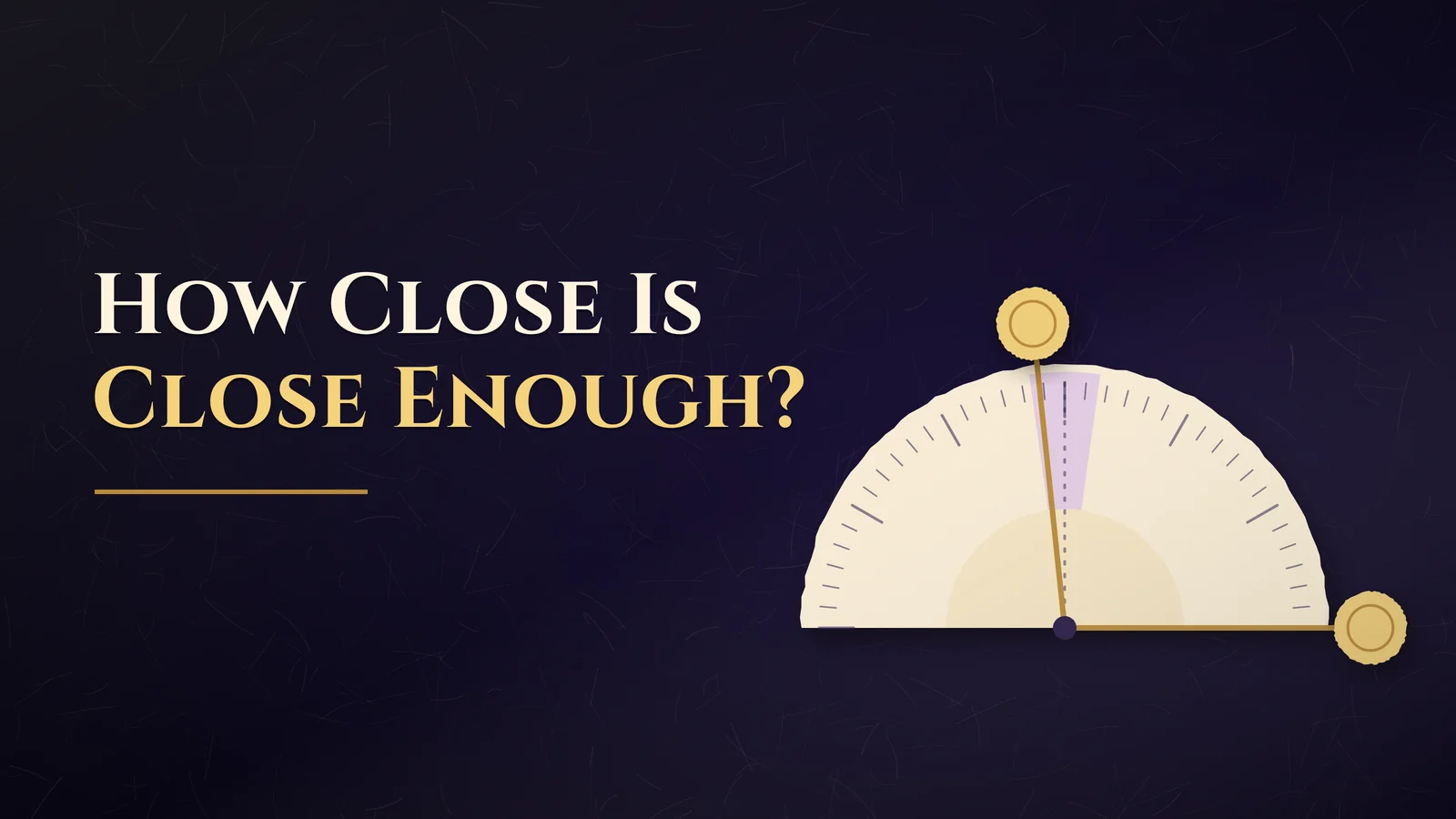
Real planets rarely stand at a perfectly round angle to each other. Venus and Mars might be 96° apart, not 90°. The orb is the gap between the actual angle and the exact one, in this case 6°. The open question is whether 6° is still close enough to call it a square.
That is where traditions and programs part ways. Kerykeion's guide to orbs states plainly that there is no universal orb table and calls common ranges "guidelines, not laws." It also notes that two astrologers looking at the same birth data can arrive at different aspect lists because they allow different orbs. The Wikipedia article makes the same point: different astrologers and traditions use differing orbs.
Why sites set their orbs differently
Here is how far apart published settings can be. These are the defaults of two well-known chart sites and one teaching recommendation, not a ranking.
- Astrotheme lists its natal orbs as 10.5° for a conjunction, 10° for an opposition, 8.3° for a trine, 7.8° for a square and 6.1° for a sextile, and adds a little extra when the Sun or Moon is involved.
- Astrodienst's chart style FAQ shows a 10° orb for the main aspects in its standard chart styles. Its Hellenistic style works very differently: 13° for the Moon and only 3° for the Sun and the other planets. The same page notes that the defaults can be changed in the options.
- Kerykeion's advice on choosing orbs suggests that beginners start tighter, for example 5° for major aspects and 8° when the Sun or Moon is involved, and widen them only later.
None of these is a measurement error. They reflect different views on a question that astrology itself has never settled: how much tolerance gives a clear picture, and how much starts to fill the chart with noise. Wide orbs catch more connections. Tight orbs keep only the strongest. The planetary positions underneath stay the same.
A second reason for different lists has nothing to do with orbs at all: some programs include minor aspects such as the quincunx (150°) or the semi-square (45°), or add points like Chiron, the lunar nodes or the Midheaven. More objects mean more possible aspects. If one list is much longer than the other, check this first.
A worked example: one square, four answers
Take a hypothetical chart with Venus at 3° Taurus and Mars at 9° Leo. Counting through the zodiac, that is 96° apart, so the pair sits 6° away from an exact square.
- With Astrotheme's 7.8° square orb, the square appears.
- With Astrodienst's standard 10°, it appears as well.
- With the beginner suggestion of 5°, it does not.
- In Astrodienst's Hellenistic style, with 3° for planets, it does not either.
Same chart, same positions, and the Venus–Mars square is either there or not, depending on one setting. Neither answer is false. They describe how strictly each method draws the line.
The more practical question is what to do with an aspect that only shows up under generous settings. Here astrologers mostly agree on one principle: the tighter the orb, the stronger the aspect is read. Astrotheme puts it directly: an almost exact aspect counts as more powerful, a wide one as less strong. So a square at 1° is treated as a central theme, while the same square at 6° or 7° is more of a background note.
Close to exact, applying, out of sign: three details that change the reading
Once an aspect is on your list, three details help you judge its weight.
How exact it is. Sort your aspects by orb if your chart site allows it, or simply read the degree figure next to each one. The two or three tightest aspects often say more about a chart than a long list of wide ones. That is also why beginners are often told to start tight: it shows the core structure before the details.
Applying or separating. In an applying aspect, the faster planet is still moving toward the exact angle. In a separating aspect, it has already passed it and is moving away. Kerykeion describes the common reading: applying aspects are felt more intensely, while separating ones describe a dynamic that has already peaked. In a birth chart, this is a refinement rather than a rule, and not every tradition gives it the same weight.
Out-of-sign aspects. Usually, the signs involved match the aspect: a square links signs three apart, a trine links signs of the same element. Sometimes the degrees and the signs disagree. Imagine, again hypothetically, Venus at 29° Cancer and Mars at 1° Scorpio. By degree, they are 92° apart, a square with a 2° orb. By sign, Cancer and Scorpio are both water signs, which normally forms a trine. Some programs show this as a square, others mark it as out of sign, and astrologers read it as a square with a softer, more mixed tone. If an aspect in your list seems to clash with the signs, this is often the reason.
What to do when your apps disagree
You do not need to pick a winner. A calmer approach works better.
- Check the settings first. Look for an option called orbs, aspect settings or chart style. Note the orb, the house system and which objects are included before you compare two lists.
- Read the degree of the orb, not just the symbol. An aspect that appears on only one site is almost always a wide one. That alone tells you it is a supporting voice, not the lead.
- Start with the tightest aspects. If a 1° square and a 7° trine both involve your Moon, the square is the stronger theme in most readings.
- Stay consistent. Choose one set of orbs and stick with it for a while. Switching settings until a chart says what you hoped to see makes the whole picture less useful.
The same habits help with relationship charts, where orb settings decide how many lines connect two people. Our piece on many red lines in synastry shows how to weigh those contacts one at a time.
The same sky, a different filter
Different aspect lists are not a sign that astrology software is unreliable. The positions of the planets are calculated from astronomical data, which is why your two sites agreed on your signs in the first place. The orb is an interpretive choice laid on top of those positions. It belongs to astrological tradition, not to astronomy, and it is openly adjustable.
House systems work in a similar way: the sky stays fixed, but the method of dividing or filtering it changes what appears on the page. If you are curious about that side, our article on Placidus and Whole Sign houses explains the difference, and the guide to your chart ruler shows another way to find the planets that carry the most weight.
So when a square shows up on one site and not on another, read the small number next to it. If it is wide, you have found a quiet thread in your chart. If it is tight, both sites should agree, and that is the one worth reading first.

From the Zodiacally community