
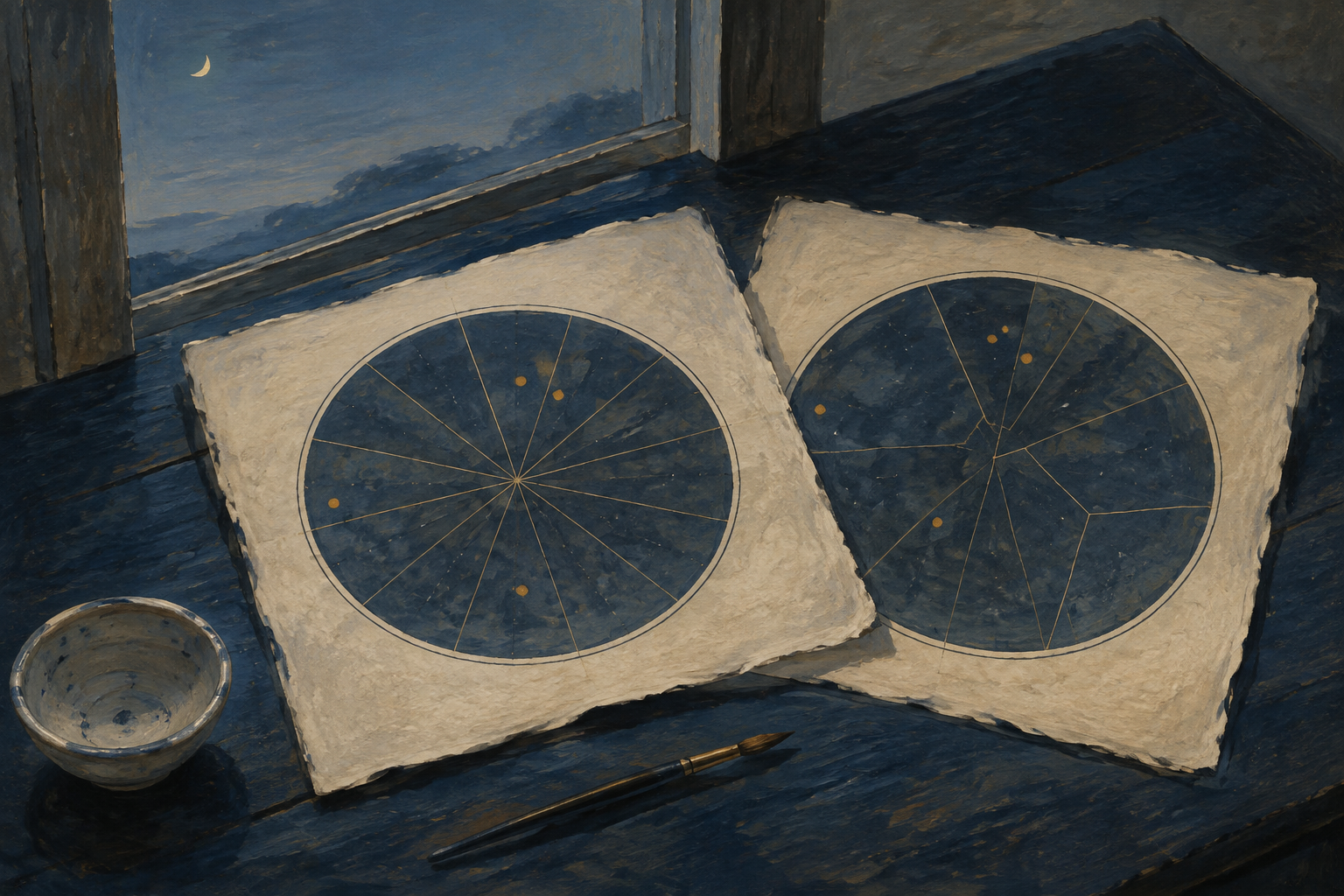
You open a second chart calculator and barely recognize your own horoscope. The Sun has moved into the next house. Venus, whose placement you have just spent an evening reading about, comes with a different interpretation. Yet you entered the same birthday. For a moment, it feels as though someone has switched the labels on a familiar map.
Often, the explanation is a change of house system: Placidus and Whole Sign divide the horoscope differently. With the same underlying calculation settings, the planets retain their zodiac positions but may be assigned to different houses. That does not make your earlier reflections worthless. Check the settings before turning a shifted line into an entirely new life story.
Why this question keeps coming up
Recent community discussions make the confusion tangible. In a Reddit thread from August 26, 2026, one person describes a group of planets switching between the fifth and sixth houses. On July 15, someone in r/beginnerastrology asked which system to follow when studying astrology and watching transits. Behind both questions is an understandable concern: which chart am I supposed to learn from?
If you use an app, watch an explanatory video, and read a personal interpretation, you may encounter several methods without seeing them clearly named. A difference between two astrological tools can start to feel like a contradiction about you. That is especially unsettling when you have already identified strongly with a house placement: a creative Venus, a private Moon, or an ambitious Sun.
Perhaps this is a useful moment to step back. A chart can open up questions. It does not have to tell you which description you must live up to from now on. Before searching for the supposedly truer version of yourself, establish what kind of map you are looking at.
What Placidus and Whole Sign do differently
The twelve astrological houses organize interpretation around different areas of life. In Whole Sign houses, the entire zodiac sign containing the Ascendant becomes the first house. The following sign becomes the second house, and so on. Each house therefore covers a complete 30-degree sign. The exact Ascendant remains a point in the chart; it does not have to sit at the beginning of that first house. Astrodienst explains this basic principle in its introduction to house systems.
Placidus is a time-based quadrant house system. Its intermediate house boundaries are calculated through time divisions related to the sky's daily motion. The Ascendant marks the beginning of the first house, and the Midheaven, or MC, marks the beginning of the tenth. The houses can span unequal portions of the zodiac. A house boundary is called a “cusp”: this means the beginning of a house, not its middle. The Astrodienst overview of house systems describes the calculation methods.
In Whole Sign, the MC is not automatically the boundary of the tenth house. It remains a separate point, with its house position depending on the particular chart. “Equal House” is also not simply another name for Whole Sign: in the usual equal-house system, the 30-degree houses begin at the exact Ascendant degree. The Astrology Podcast episode on house division compares these constructions. Their differences can be explained methodically; those differences alone do not establish an astrological effect.
An example: the same Venus, a different area of life
Imagine a simplified example with an Ascendant at 20 degrees Libra and Venus at 10 degrees Libra. In Whole Sign, all of Libra belongs to the first house, so Venus is in the first house. In Placidus, the first house begins at 20 degrees Libra. Venus falls before that boundary and therefore outside the first house. Its exact house depends on the remaining calculated boundaries, which cannot all be determined from those two positions alone.
The key observation is that Venus stays at 10 degrees Libra. Neither the planet nor its zodiac sign has changed because you selected another house system. Its assignment to an area of life has changed. If an actual calculation places Venus in the twelfth house in one system and the first in another, you can describe that difference without immediately ranking competing versions of your personality.
As an open reflection exercise, try putting two questions next to each other: “How do I show other people what I enjoy?” and “What would I rather keep to myself?” Different situations may come to mind. You might happily dress to stand out at a party while telling only a few people about a new relationship. Both can be true. This is not an interpretation of your personal chart; it illustrates why open questions can be more useful than fixed labels.
Write down a counterexample to every description that immediately convinces you. When do you seek visibility despite thinking of yourself as reserved? When do you need privacy despite enjoying attention? Your experience can remain larger than the sentence you are currently using to describe it.
Which house system is right?
A mathematically clear calculation does not establish that the resulting personality interpretation is accurate. A description feeling right is not scientific evidence that it is valid. Within astrological practice, house systems also belong to different methodological traditions. If you are working through a course or book, it is practical to start with the system it explains and learn its terms carefully.
The popular shorthand “Placidus for personality, Whole Sign for transits” is not a universal rule. Ask which system a particular tutorial assumes and why. Constantly switching methods during a reading can make it difficult to remember which statement came from which setting. A consistently kept notebook is more useful here than another vote in a comment thread.
There are genuine technical limitations, too. Placidus calculations can become problematic or unavailable at polar latitudes. The Swiss Ephemeris documentation describes this behavior and fallback calculations. A calculator may therefore use another system or display a warning. Check those messages if your birthplace is very far north or south.
For your own learning, you could keep one system for a few weeks. Record what you understand, what remains unclear, and where an interpretation does not fit your experience. Later, you can deliberately compare a second method. You do not need to declare a permanent allegiance today to look at your horoscope thoughtfully.
When two apps disagree: check these settings
Not every difference comes from the house system. First establish whether both calculations actually use the same starting data. Accidentally selecting another town with the same name can make the comparison misleading. Work through the settings individually instead of changing several at once.
- Birth date and time: Are the day and month correct? Is the time identical in both entries, including any possible confusion between AM and PM?
- Birthplace and time conversion: Are the location, historical time zone, and daylight saving time handled correctly? Do not automatically apply today's time offset to an earlier birth date.
- Zodiac: Are both calculators using a tropical zodiac, or both using a sidereal one? Changing this affects sign positions and is different from changing houses.
- House system: Does the setting explicitly say Placidus, Whole Sign, or another method? Watch for notices about automatic fallback calculations.
- Chart type: Are you comparing two natal charts? A transit chart or relocated chart answers a different question and is not an identical counterpart.
If your birth time is approximate, keep that uncertainty visible. Whole Sign does not automatically make an imprecise time irrelevant: if the Ascendant changes signs within the possible time window, the house assignments change too. When the inputs remain uncertain, the interpretation can remain provisional. You do not have to fill a gap with an especially persuasive story.
What you can do with this today
Take ten quiet minutes and choose one placement that confuses you. Start by writing down the data: planet, sign, degree, house, and selected system. Compare that same placement in the second calculation. Mark what has stayed the same. Only then read the different house descriptions. This order gives you a stable starting point before your attention gets lost in an expanding list of meanings.
Turn each description into a question you can observe in everyday life. “I need solitude” might become: “In which conversations would I like more time before sharing something personal?” “I want to be seen” might become: “Where am I holding back an idea I would like to share?” Neither requires a dramatic prediction or a complete revision of your self-image.
Journaling questions for your comparison:
- Which statement moved me, and what specific memory do I connect with it?
- Where does that same statement clearly fail to describe my behavior?
- What uncertainty am I trying to soothe with a definitive chart answer?
- What small action would still make sense if I changed house systems tomorrow?
That action might be an honest message, an intentionally quiet hour, or showing someone a piece of work that matters to you. Let it emerge from the situation you have actually observed. Your chart can offer a language for reflection; the decision remains yours. If you would like to explore how these themes appear in your own chart, you can view your reading in Zodiacally.
Astrology and Human Design are for self-reflection and entertainment and do not replace professional advice.



From the Zodiacally community