
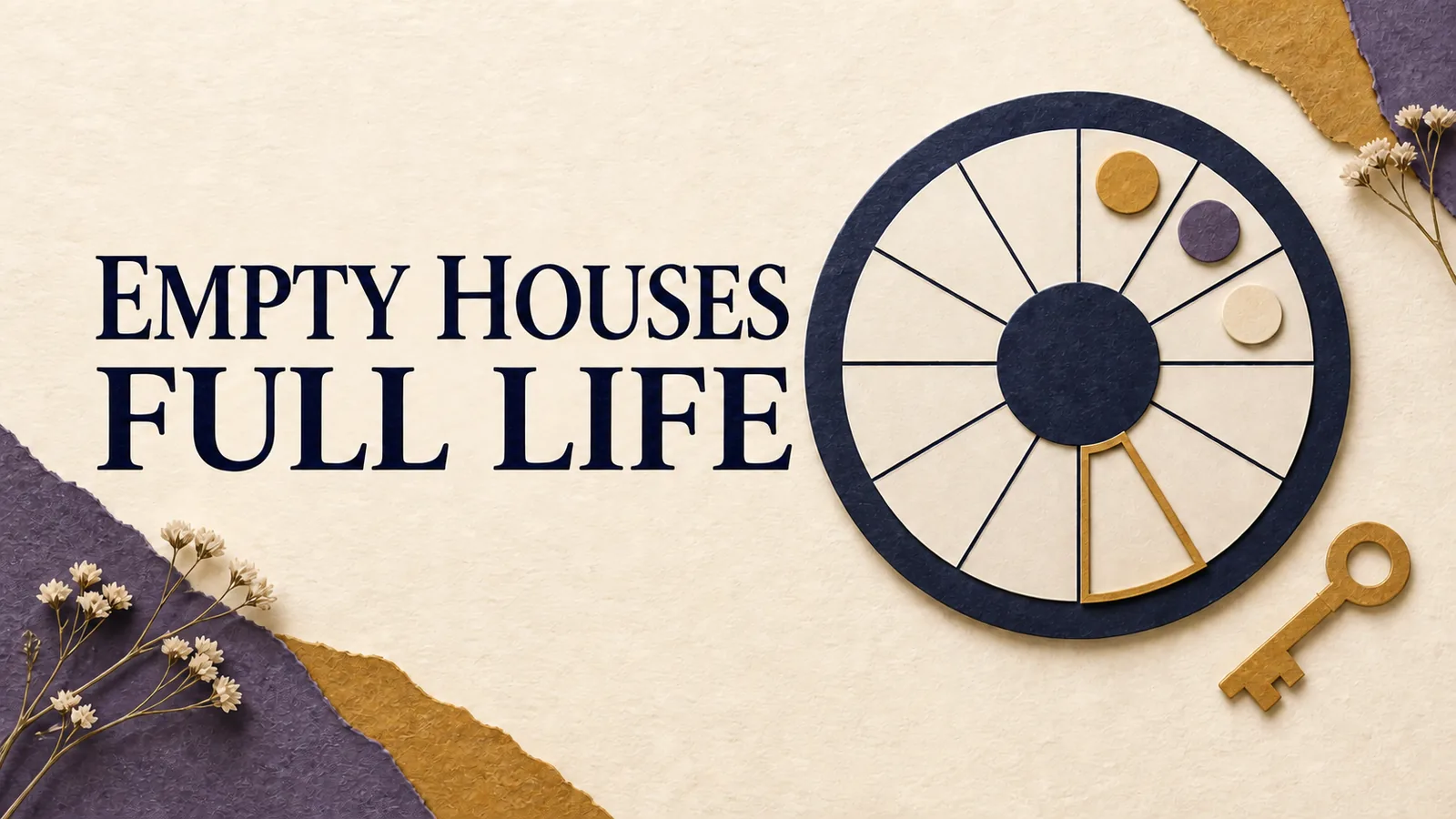
You open your birth chart and look for the symbols first. Several crowd into one section, while others appear almost untouched. Then you read that the seventh house concerns partnerships, look back at its blank space, and wonder: am I missing something that other people have?
An empty house in astrology initially means only that none of the natal planets being considered is placed there. It does not mean that you cannot experience that area of life. An empty relationship house does not exclude love, just as an empty career house does not prevent you from having a vocation. Blank sections are a normal part of a birth chart.
If you are just getting to know your chart, you can take those blank sections in stride. They can still be read astrologically through the sign at the beginning of the house and the planet associated with that sign. We will use the seventh house to explore how this works and the everyday questions it might bring up.
What “empty” actually means in a birth chart
The twelve astrological houses organize interpretation around different areas of life. The fourth, for example, is associated with home and origins, the seventh with partnerships, and the tenth with career and public role. Astrodienst's overview of the houses explains this division and its dependence on birthplace, time, and the house system used.
Many Western birth charts consider ten main factors: the Sun, the Moon, and the planets from Mercury through Pluto. In this astrological vocabulary, the Sun and Moon are often included under “planets,” although astronomically they are a star and a moon. Ten such positions cannot occupy all twelve houses. When several occupy the same house, more of the remaining houses are left unoccupied.
Additional points can make the chart look busier, including the lunar nodes, asteroids, or Chiron. It is therefore useful to ask what the particular display actually includes. “Without major planets” and “without any symbols” are not necessarily identical descriptions. Your chart settings will usually show which celestial bodies and points are included.
Astrodienst's entry on an unoccupied house also explicitly distinguishes it from an area in which nothing happens. A house containing planets offers additional clues for interpretation. An empty one is explored through other connections. Friendships, for instance, may be very important to you even with no planet shown in your eleventh house.
The house ruler: Where to look next
The boundary at the beginning of a house is called its cusp. It means the start of the house, rather than its middle. In many house systems, a line marks that boundary and points to a particular part of the zodiac. The sign at that starting point has an associated planet in astrological tradition: its sign ruler.
In the method we are using here, that planet also becomes the ruler of the house in question. You move from the house boundary to the sign, then from the sign to its planet. If Taurus or Libra is at the beginning, for example, you look at Venus. The overview of sign rulers explains these assignments.
You may have come across the shortcut “Libra equals the seventh house.” To find a house ruler, though, you need the sign at the beginning of that house in your own chart. A simple distinction helps: the house describes an area of life, while the sign brings its own symbolism. They appear in different combinations from one birth chart to another.
The ruler may itself occupy a different house. Astrologers use that placement to connect two areas of life. Chris Brennan and Sam Ogden discuss the method in their episode about house rulers. It is an interpretive technique within astrology, rather than evidence of something causing events in your life.
For a first look, three notes are enough: which house interests you, which sign begins there, and where its ruler is placed. You do not need to understand every connecting line in the chart before you can begin.
An empty seventh house, a straightforward example
Let’s use a simplified, hypothetical birth chart: Aries rising, Whole Sign houses, an empty seventh house in Libra, and Venus in Aquarius in the eleventh house. In Whole Sign houses, each house corresponds to an entire zodiac sign, so the sequence can be counted from Aries as the first house.
The first step is that this seventh house is read through Libra and therefore Venus. Next, we consider Venus in the eleventh house, which astrology associates with friendships and groups, among other topics. We could express that connection as a question: what role do friendship, shared interests, and social circles play in my partnerships?
One possible reading is that friendship within a relationship matters especially to you: laughing together, sharing interests, and talking about ordinary things. Another question concerns your shared social circle. How much time do you spend with the group, and how much together as a couple? Your own experience will help you decide which questions feel relevant.
Suppose this invented person spends every free evening with friends, while their partner wants more time together. Looking at their calendar, they might ask: “Which evenings are for us, and which are for the group?” Perhaps they arrange an evening together and leave the weekend open. The abstract connection between two houses becomes a conversation about closeness and how they spend their time.
An empty house is still part of your life.
The example does not predict where someone will meet a partner or how the relationship will unfold. A partnership also develops through the way two people treat each other: whether they listen, keep agreements, and give each other room.
Three shortcuts that create more confusion
The first shortcut is “empty means unimportant.” You may encounter that phrase as a simplified way of weighting astrological topics. Yet an area of life can matter deeply because of a new responsibility or something you want. Think of moving home: finding somewhere to live can take up a great deal of your attention, even with an empty fourth house.
The second is “I will just use the nearest planet.” On a small screen, it is understandable to look for the closest symbol. To find the house ruler, though, you follow the sign at the beginning of the house. If the lines or symbols are crowded together, the position list alongside the chart can help you see where everything belongs.
The third is “another house system will fix the problem.” Different systems can assign a planet to different houses. That changes the display and potentially the astrological reading. You may then find yourself asking about an empty house elsewhere in the chart. Our article on Placidus and Whole Sign houses explains the methodological differences in more detail.
Also pay attention to the birth time. If it is approximate, a house placement that looks precise may be uncertain. A brief note such as “approximate birth time” can help you keep this in mind as you read. Where a placement is uncertain, it makes sense to leave the interpretation open too.
What you can do with this today
For a first attempt, one empty house that makes you curious is plenty. Perhaps you want to understand why a blank chart section makes you uneasy. Perhaps you simply want a starting point for reading your birth chart more independently.
Have your chart and something to write on nearby. Make a quick note of the house system and how accurately you know your birth time. Then follow the three steps: find the house, read the sign at its beginning, and locate the associated planet. Beside “Venus in the eleventh house,” you might write: “What role does friendship play in my relationships?” This keeps the chart placement and your personal question side by side.
Perhaps something from the past few weeks comes to mind: a lovely evening, a postponed plan, or a conversation you are still thinking about. What mattered to you? What would you have liked? You can also start with the memory and then see whether the astrological question adds anything to your understanding.
Journaling questions for a more open perspective
- What worry did I attach to the word “empty”?
- Where does this area of life already exist, even without a planet in its house?
- What question does the house ruler suggest without turning into a prediction?
- Which experience does not fit my first interpretation?
- What small step would seem worthwhile even without an astrological explanation?
Your answers can lead to something ordinary: an evening together, a question about a responsibility, or time for a hobby you have neglected. Perhaps you would like to call someone or talk through a plan together. A small step is enough; you can see how it felt afterward.
If nothing comes to mind, you can set the question aside. Not every interpretation fits your experience. A different connection may catch your interest the next time you look at your chart.
There’s more to your life than your chart
An empty house can be explored just as a house containing planets can. The sign at its beginning and its ruler give you a starting point. From there, you can follow what interests you: your relationships, your home, or the things you would like to make more time for.
Astrology and Human Design are for self-reflection and entertainment and do not replace professional advice.
If you would like to explore more connections in your chart, a personal Zodiacally reading can offer a next step. You might find a question that stays with you for a while, or words for something you have been noticing for some time.
The next time you look at that blank section, you might think of an evening together or a conversation with a friend. There is still no planet in that part of the drawing. In your everyday life, something is already there.

From the Zodiacally community