
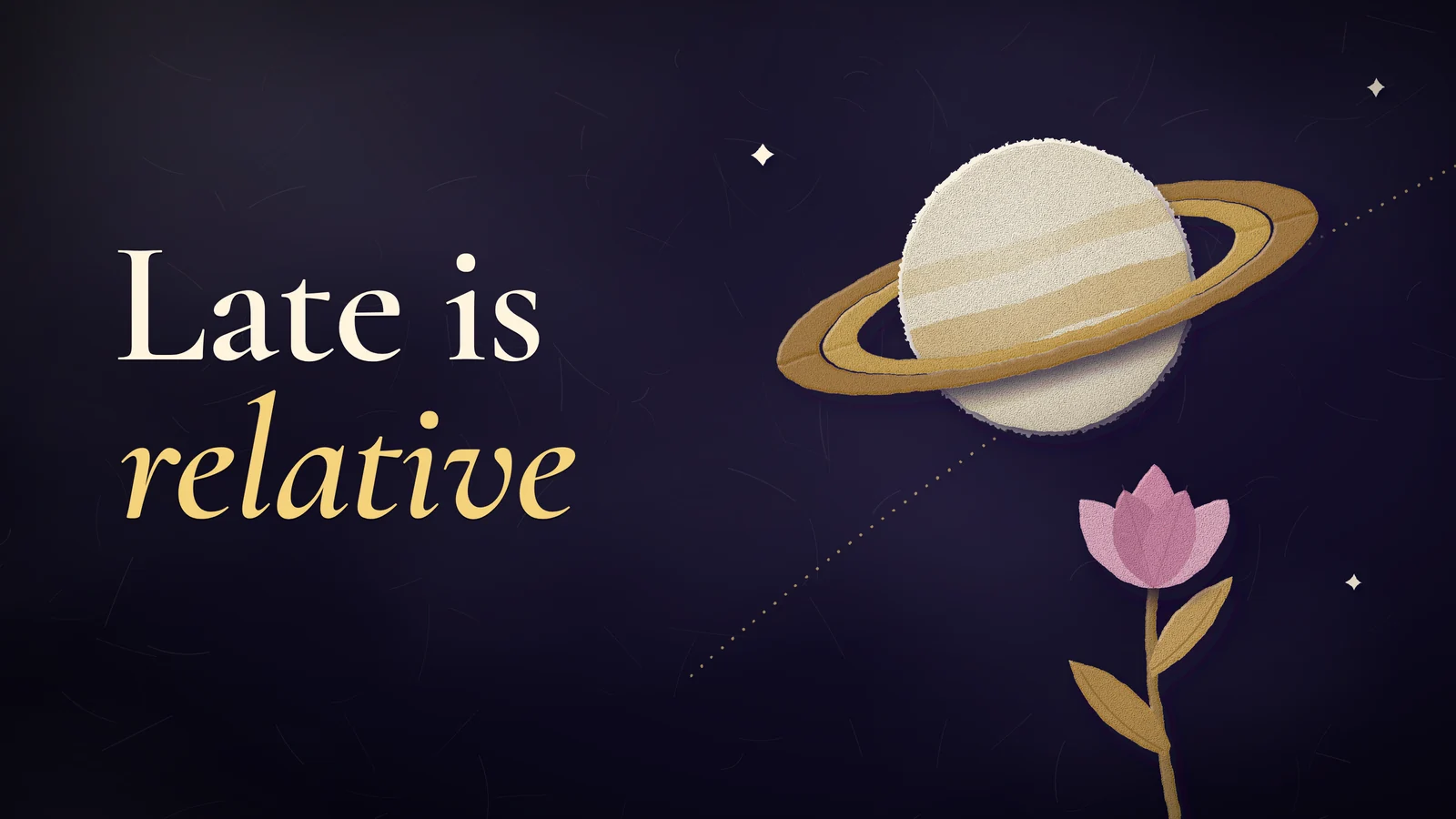
Your degree took longer than you planned, your first permanent job came in your late twenties, and while friends are sending out wedding invitations and posting photos with new house keys, you’re still figuring out where your career is supposed to go. At some point a question creeps in: could you see this in a birth chart? Is there such a thing as a late bloomer placement?
Astrological tradition does have a planet in charge of this feeling: Saturn. It is the slowest planet visible to the naked eye, and in astrology it stands for time, limits, structure, and maturity. Astrodienst’s encyclopedia entry on Saturn describes it as a symbol of limitation and hardship, but also as a pointer to where patience and hard work may pay off later in life.
What Saturn doesn’t give you is a schedule. No chart decides at what age someone finishes school, earns a decent living, or feels settled. In astrological language, Saturn describes a way of building things: slowly, through repetition, sometimes by way of detours. Whether that counts as “late” depends mostly on what you’re comparing yourself to.
Why Saturn, of all planets, stands for “late”
The connection starts in the sky. Saturn moves more slowly than any other planet you can see without a telescope. According to NASA’s Saturn fact sheet, one orbit measured against the vernal equinox, the reference point of the Western zodiac, takes 10,746.94 days, or about 29.4 years. On average, Saturn spends around two and a half years in each zodiac sign.
Astrology turned that slowness into meaning early on. In the doctrine of the ages of life in Ptolemy’s Tetrabiblos, written in the second century, Saturn is given the last stage of life, explicitly in keeping with the sluggishness of its motion. Mythology plays along: Kronos, whom the Romans identified with their Saturn, was seen as a personification of time, and the Roman Saturn was also a god of agriculture and the harvest. Between sowing and harvest lies a stretch of time that can’t simply be skipped.
That a slow planet stands for slow development is a symbolic analogy, not a measured effect on people. Within that symbolism, though, Saturn has two faces. Traditional astrology feared it as a bringer of misfortune. Modern psychological approaches emphasize that skill and stability can grow precisely where progress feels sluggish. You’ll find both readings today, often in the same forum thread.
Which placements are read as late bloomer signs
Ask about late bloomers in an astrology forum and the answers usually point to placements where Saturn is especially prominent. The most common candidates:
- Saturn in the first or tenth house: Houses are the twelve areas of life in a chart. The tenth house is linked to career and public role, the first to self-image and the way you come across. Cafe Astrology connects both placements with patience: in the first house, self-confidence grows with experience; in the tenth, people often take pride in a self-made path.
- Saturn close to the Ascendant or Midheaven: The Ascendant is the degree of the zodiac rising in the east at the time of birth; the Midheaven (MC) is the degree that was culminating at the time of birth, reaching the highest point of its daily path. Planets near these points are considered emphasized.
- Close aspects to the Sun or Moon: Aspects are angular relationships between planets, such as a conjunction or a square. According to Astrodienst, Saturn’s house and aspects show where and how someone is likely to feel inhibited or insecure, and overcoming that takes time and work.
- Capricorn emphasis: Saturn rules Capricorn. A Capricorn Ascendant makes Saturn the ruler of the whole chart, and several planets in Capricorn bring it to the foreground as well.
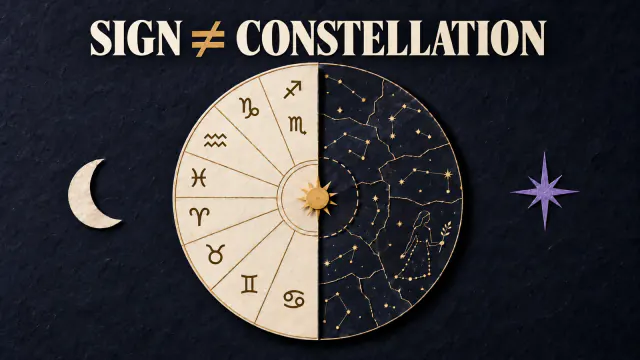
It matters what the sign alone can’t do. Because Saturn stays in one sign for about two and a half years, everyone born during that window shares its sign. An entire age group can’t all be running late at once. House and aspects are more personal, and the house requires an accurate birth time. Depending on the house system, Saturn may even land in a different house; our article on Placidus and Whole Sign explains why.
There’s an honest limit here, too: these signs are interpretive traditions, not tested predictions. Many people with a prominent Saturn don’t experience their lives as delayed, and many with a bumpy start have none of these placements. Claims like “your career is permanently blocked” go far beyond what a symbolic system can responsibly say. In astrological terms, a prominent Saturn describes a pace rather than a ban.
The Saturn return: a cycle, not a deadline
Few Saturn topics get as much attention as the Saturn return. It refers to the period when transiting Saturn comes back to the position it held when you were born. The first return happens around age 29, roughly between 28 and 30 depending on how it’s counted; the second between about 57 and 60; and a third in the mid-to-late 80s. That’s also how The Astrology Podcast sums it up in an episode on the Saturn return.
Astrologers consider the first return an important stage on the way to maturity. Typical themes include taking stock, responsibility, and the question of which structures should carry your life. Alongside constructive work toward goals, the podcast also mentions losses: people or things that leave your life during this time. How intense it feels varies a lot; most charts, the hosts note, aren’t extreme in either direction.
The Saturn return is rarely a single date. Because Saturn goes retrograde, meaning it appears to move backward as seen from Earth, it can cross the same degree up to three times. Some astrologers even count the entire period during which Saturn travels through your birth sign.
A calculated example: someone born on April 1, 1997, has Saturn at 10°27′ Aries. Transiting Saturn first reached that exact degree on May 12, 2026. It returns to it while retrograde on October 15, 2026, and crosses it a third time on February 3, 2027. These dates were calculated with the Zodiacally ephemeris, based on the JPL DE440 planetary ephemeris (NASA/JPL), in the tropical zodiac and are given in UTC. Birth time shifts Saturn’s position by only a fraction of a degree.
Who is having a Saturn return right now
For people born in the late 1990s, this is very concrete right now. Saturn entered Aries on May 25, 2025, slipped back into Pisces on September 1, 2025, and returned to Aries on February 14, 2026, where it stays until April 13, 2028 (all dates in UTC). CHANI’s guide to Saturn in Aries lists the same periods; because it uses US time, some dates appear one day earlier.
Saturn is in Aries for people born between April 7, 1996, and March 1, 1999, with one gap: between June 9 and October 25, 1998, Saturn had already moved into Taurus. If your birthday falls within this window, your first Saturn return takes place between 2025 and 2028, at around age 28 to 30. The second Saturn return in Aries applies to people born between March 3, 1967, and April 29, 1969. If you were born right on one of these changeover dates, check your chart.
From July 26 to December 10, 2026 (UTC), Saturn is retrograde, moving back from just under 15 to just under 8 degrees of Aries. Anyone with natal Saturn in that range therefore gets several passes, like the example above. What the retrograde can mean as a collective theme is covered in our article on Saturn retrograde in Aries 2026.
If you read charts traditionally, there’s one more detail: in classical dignity doctrine, Saturn in Aries is in its “fall.” According to Astrodienst, planets in fall are considered weakened, or at least inclined to behave in ways foreign to their nature. You can read that as friction: Saturn stands for patience and form, Aries for the quick start. For anyone in the middle of this Saturn return, it’s a fitting image for why waiting can feel especially impatient.
“Late” compared to whom?
This is where it helps to look up from the chart. Feeling late always assumes a yardstick, and that yardstick moves. In Germany, according to the Federal Statistical Office, never-married women in the early 1970s married at about 23 on average, men at about 25. In 2025, the average age at first marriage was 33 for women and 35.3 for men.
So being unmarried at 29 isn’t late by the German national average: the average age at first marriage is several years higher. Yet the inner timeline many people measure themselves against often comes from another era or setting: from parents, from a circle of friends, or from a feed that mostly shows milestones.
Saturn’s symbolism offers a different question than comparison. Not “Why am I behind?” but “What am I building that needs time?” That question can be answered with your own life, no average required.
How to look at your Saturn without measuring yourself against it
If you’d like a closer look at your own Saturn, a few calm steps help:
- Find the sign and degree: Your birth date is enough. You only need the birth time for the house.
- Look at house and aspects: Which area of life does Saturn occupy, and does it closely touch your Sun, Moon, Ascendant, or Midheaven? In astrological terms, that’s where things tend to take their time.
- Check your own return: Compare your Saturn’s degree with transiting Saturn and note the dates of the exact hits. The weeks before and after say more than any single day.
- Translate “delay”: Turn “everything takes longer for me” into a concrete question, such as: How do I notice progress that doesn’t show up as a milestone? And whose timeline am I comparing myself to right now?
Maybe a Saturn placement describes quite well why some things are harder for you than for others. Maybe you barely recognize yourself in it. Both are useful answers.
Saturn needs nearly three decades to complete one orbit and still moves forward a little every year. For anyone who feels late, that may be the most helpful way to read it: not as falling behind, but as a pace of your own.
If you’d like more explainers like this, join the free Zodiacally newsletter. After you confirm your email, you can download the moon calendar for October through December 2026 as a PDF. You also get a one-time gift of 14 days of Premium when you sign in with a verified account using the same email address; it doesn’t turn into a paid subscription automatically.

From the Zodiacally community