
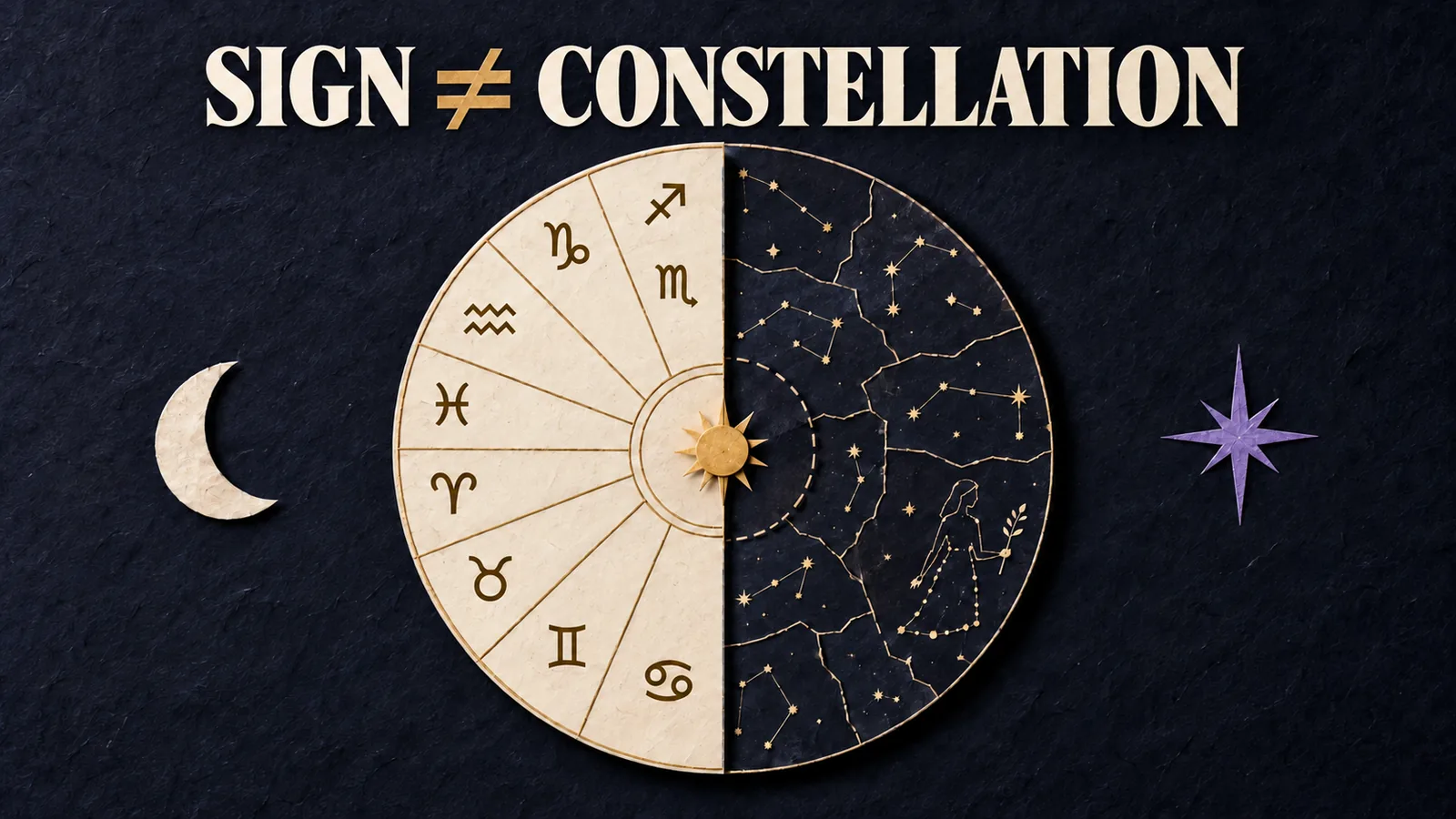
You open a sky map on September 23. The Sun is positioned in front of the constellation Virgo. Then you switch to a Western horoscope, where Libra season begins at the very same minute. One sky, two maps, and apparently two different answers.
The short explanation is that a zodiac sign is not the same thing as a constellation. Western tropical astrology divides the Sun’s apparent path into twelve equal sections and anchors them to seasonal turning points. Astronomy uses constellations as uneven regions of the sky with defined boundaries. A sidereal zodiac also uses twelve equal astrological signs, but places its starting point differently from the tropical system.
That is why Libra season can begin at the September equinox on September 23, 2026, at 00:05 UTC, while the Sun remains astronomically in front of Virgo. EarthSky confirms the 2026 equinox time and separately explains the Sun’s position against Virgo at this time of year.
This is not an astronomical mistake or a secret correction to your horoscope. These are different reference systems. Before asking which map is “the real one,” it helps to notice that they were designed to answer different questions.
One Sun, three different maps
Imagine describing the same city with a political map, a terrain map, and a subway diagram. None is identical to the physical landscape. Each emphasizes a different set of relationships.
The distinction between constellations, the tropical zodiac, and the sidereal zodiac works in a similar way:
- Astronomical constellations are regions of the celestial sphere. Their modern boundaries are defined, but their sizes are unequal. Along the Sun’s apparent path, Virgo covers far more space than Scorpius. Ophiuchus also lies along that path.
- The tropical zodiac contains twelve exactly equal sections of 30 degrees. Its starting point is the March equinox, so the September equinox marks 0 degrees Libra. The system stays tied to seasonal turning points.
- The sidereal zodiac also contains twelve equal 30-degree signs. It uses a starting point offset from the tropical zodiac to align the signs more closely with the stellar background. Different astrological schools calculate this offset, called the ayanamsha, in slightly different ways.
That last distinction is often lost. “Sidereal” does not automatically mean that the astrological signs follow the modern boundaries of astronomical constellations exactly. Most sidereal zodiacs are still geometric twelve-sign systems with equal sections. A map based on the constellations’ actual boundaries would be yet another model.
Signs are equal coordinate sectors. Constellations are unequal regions of the sky. Shared names do not make them identical.
Why Libra season begins at the equinox
In the tropical zodiac, Aries begins at the March equinox. From there, the circle is divided into twelve equal sections. Six signs, or 180 degrees, later comes the beginning of Libra. That places 0 degrees Libra at the September equinox, regardless of which constellation forms the Sun’s background.
When Western astrology refers to Libra season 2026, it does not mean, “The Sun has now entered the astronomical boundary of the constellation Libra.” It means the Sun has reached the section named Libra within the tropical coordinate system.
This difference changes the precision of our language. “The Sun is in Libra” is a correct system statement within tropical astrology. For the same moment, an astronomically precise sentence would be, “From Earth, the Sun appears in front of the constellation Virgo.” Both can be true when their maps are named.
The equinox itself is an astronomical event. It occurs when the Sun’s apparent position crosses the celestial equator from north to south. Although the word equinox suggests equal night, atmospheric refraction and the definitions of sunrise and sunset mean that daylight and darkness are not exactly twelve hours everywhere on that date. Astrology’s Libra symbolism of balance belongs to a symbolic tradition; it is not an astronomical measurement of personality or fairness in relationships.
Keeping these layers separate makes both easier to understand. The equinox does not need an astrological interpretation to be a real celestial event. Astrological symbolism does not need to masquerade as physical science to be read as a cultural language for reflection.
Precession: why the stellar background shifts
Why did signs and constellations appear more closely aligned in ancient descriptions than they do now? The answer is the precession of the equinoxes.
Earth’s rotational axis does not point in exactly the same direction forever. It traces a very slow cone, somewhat like the axis of a spinning top. NASA describes this cycle as lasting about 26,000 years. As a result, the intersection points of the celestial equator and the ecliptic gradually move relative to the background stars.
The stars are not suddenly racing from one sign into another. The seasonal reference points shift against the constellations over centuries. EarthSky gives the approximate rate as one degree every 72 years. Over roughly 2,160 years, that adds up to about 30 degrees—the width of one astrological sign.
The tropical zodiac handles this shift by keeping its zero point fixed to the March equinox. Its signs remain oriented to seasonal points while the constellations behind them slowly change. Sidereal systems account for the offset and position their signs differently.
This is the missing context behind recurring headlines that claim “your zodiac sign is wrong.” Those stories typically compare a tropical sign label with an astronomical constellation position and present the mismatch as a correction. Precession is not a new discovery, however. Astrological traditions developed different systems for working with it long ago.
Why Virgo lasts much longer than Libra
Another source of confusion is the calendar that supposedly lists the “real zodiac dates.” Astronomical constellations are not twelve equal slices. Their modern borders trace irregular lines across the sky, so the Sun spends different amounts of time in front of each one.
EarthSky places the Sun in front of Virgo from about September 16 to October 30. The exact boundary-crossing time can vary slightly by year and calculation, but the essential point is clear: at the September equinox, the Sun has not yet left the astronomical constellation Virgo.
There is a visual paradox here. You cannot see the constellation behind the Sun during the day because sunlight overwhelms the stars. “In front of Virgo” means that if you plotted the Sun on a star chart and removed the daylight, it would fall within the region assigned to Virgo.
Ophiuchus creates the same confusion on a larger scale. The Sun’s path crosses this astronomical constellation, even though the classical astrological zodiac uses twelve signs. That does not automatically make Ophiuchus a “new” thirteenth tropical sign. It shows, once again, that a twelve-part symbolic circle is not the same object as a list of every astronomical constellation region intersected by the ecliptic.
So when a sky app displays different date boundaries from a horoscope, the first question is not, Which one is wrong? Ask instead: Is it showing signs or constellations, and which zodiac system is it using?
Tropical or sidereal: what changes in a chart?
In a personal birth chart, changing systems can move several planets into different signs. Your birth time has not changed, and neither have the observed planetary positions. What changes is the reference grid used to name astrological longitudes.
A tropical chart places 0 degrees Aries at the March equinox. A sidereal chart subtracts an ayanamsha to position the signs relative to the stellar background. Because sidereal traditions can use different ayanamshas, a meaningful comparison should always identify the specific calculation.
This is why pulling isolated placements from several systems can create more noise than insight. “My tropical Sun is in Libra, but my sidereal Sun is in Virgo” is not a contradiction like receiving two incompatible blood types. It is two astrological readings of the same sky time, based on different reference points, traditions, and interpretive rules.
Astronomy cannot decide which of those systems you should use. It can describe positions, movements, and constellation boundaries. It does not establish that either tropical or sidereal signs cause personality traits. Within astrological practice, consistency is therefore more useful than hunting for a single victorious map: know which system calculated the chart, then read its symbols within that system’s language.
What you can do with this today
You do not need a new identity, and you do not have to replace your familiar Sun sign in a hurry. A small map check is more useful:
- Check whether a horoscope or chart is calculated using the tropical or sidereal zodiac.
- In a sky app, notice whether the overlay shows astronomical constellations or astrological signs.
- Read claims about a “wrong zodiac sign” closely enough to see whether signs and constellations are being mixed together.
- When comparing two charts, record the zodiac system, ayanamsha, and house system instead of comparing only isolated sign labels.
Journaling questions
- What answer am I actually looking for: an astronomical position or an astrological interpretation?
- Do I name the system before comparing two chart placements?
- Which parts of astrological language help me symbolically, and which do I accidentally treat as scientific findings?
- What changes in my interpretation when I view the same sky time through a different map?
When you look at a personal reading, the calculation framework matters. Not because another system reveals a hidden “true self,” but because careful interpretation begins with a clearly named map.
The September equinox offers a vivid example: Libra begins seasonally while the Sun stands against Virgo in the sky. The heavens are not contradicting themselves. We have simply invented more than one way to organize them.


From the Zodiacally community