
You have opened your birth chart and looked up the first few placements: Sun, Moon, rising sign. Then another term appears: chart ruler. Perhaps a different calculator also gives you a dominant planet. Now you have two names on the screen, and you are wondering which one is supposed to matter most.
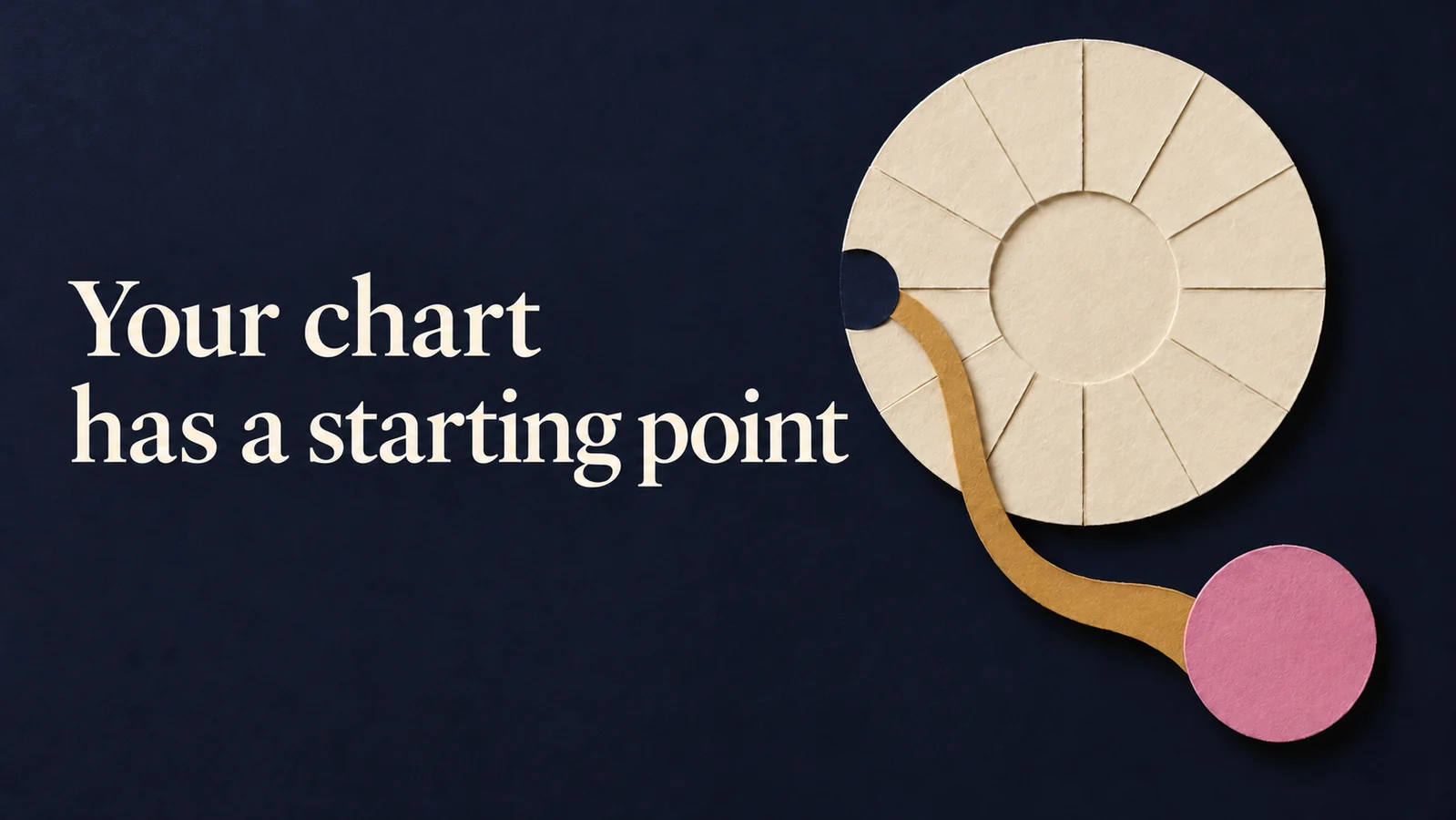
Here, chart ruler means the planet that rules the sign of your Ascendant. For Libra rising, that is Venus; for Virgo rising, Mercury. This assignment does not depend on how many planets occupy a sign or which planet receives the most points in a ranking.
Its particular role comes from a connection within the chart: from the Ascendant to a planet, and then to that planet's placement. You do not need to understand the whole chart at once. You can begin by following this one connection.
Start with the Ascendant
The Ascendant, often marked AC or ASC, is the degree of the zodiac rising on the eastern horizon at the time and place of birth. It is a calculated point in the chart. The sign containing it is your rising sign. Astrotheme explains how the Ascendant connects to the chart ruler.
In astrological interpretation, the Ascendant is associated with how someone meets new situations and presents themselves to the world. Its ruler adds another layer: Which sign does the assigned planet occupy? Which house is it in? How is it connected to other factors in the chart?
Your Sun sign does not determine this assignment. With a Taurus Sun and Libra rising, Venus happens to rule both signs. With a Taurus Sun and Virgo rising, however, Mercury is the chart ruler. Look for the AC first, even if your Sun sign is the placement you know best.
You need a reasonably reliable birth time and the correct birthplace to establish it. An uncertain time can change the rising sign, especially when the Ascendant is close to a sign boundary. Leisa Schaim and Chris Brennan demonstrate this in their introduction to reading charts. A rounded birth time belongs in the interpretation; it is useful information about how certain the starting point is.
If your birth time is unknown, this question can remain open. A calculator that substitutes noon has not established a reliable Ascendant for you. You can explore other placements while keeping the ruler of a provisional AC provisional too. There is no need to turn a convenient default into a personal certainty.
Which planet rules your rising sign?
Astrological rulership is a traditional assignment connecting signs to planets. The word does not describe physical control over a person. The classical system uses the Sun and Moon alongside the five planets known at the time. Astrologers refer to these as the seven planets, although the Sun and Moon are different kinds of celestial bodies in astronomy.
Grouping the assignments by planet makes them easier to follow:
- Mars: Aries and, traditionally, Scorpio.
- Venus: Taurus and Libra.
- Mercury: Gemini and Virgo.
- Moon: Cancer.
- Sun: Leo.
- Jupiter: Sagittarius and, traditionally, Pisces.
- Saturn: Capricorn and, traditionally, Aquarius.
Scorpio, Aquarius, and Pisces also have modern rulers: Pluto, Uranus, and Neptune, respectively. Astrotheme's overview includes both sets of assignments. If you have Aquarius rising, one source may name Saturn and another Uranus, even though both use the same birth details.
Naming the method helps: “Saturn as the traditional ruler of my Aquarius Ascendant” is clearer than “Maybe my ruler is actually Uranus.” Traditional approaches use Saturn; modern approaches may use Uranus as the ruler or consider it alongside Saturn. Their roles in a complete interpretation depend on the school of astrology being used.
For an initial comparison, you can keep the assignments explicit and examine the planets separately. You do not have to merge everything they signify into one sentence. This makes it easier to see which interpretation follows from which method, and to ask a useful question when two explanations differ.
Follow the placement: Planet, sign, house
“My chart ruler is Venus” answers the question of its name. The next stage is understanding its placement. Your Sun, Moon, and other planets still matter; Venus has gained a particular connection to your Ascendant.
You can read further in three steps. The planet introduces a symbolic topic. For Venus, these include affection, pleasure, taste, and ways of forming connections. The sign adds the style in which that topic is interpreted. The house identifies an astrological area of life.
Following the ruler of the first house to the house it occupies links different areas of the chart. Cafe Astrology describes this method of reading house rulers. A planet does not have to occupy the first house to rule it. Your Ascendant ruler might be in the ninth house, for example, while retaining its rulership of your rising sign.
Aspects are angular relationships, such as a conjunction or square. They add information about the planet's connections to other chart factors. In First Steps in Reading a Birth Chart, the Ascendant ruler's house, sign, and aspects are considered early in the reading. That gives you a manageable sequence: understand the placement, then add the closest connections.
The house system matters too. It can change a planet's house assignment while the planet remains in the same sign. If your chart ruler appears in different houses in two charts, our guide to Placidus and Whole Sign houses explains that distinction. Identifying the ruling planet and identifying its house are questions you can resolve separately.
An example: Libra rising, Venus in Gemini
Consider a hypothetical learning example, rather than a calculated personal horoscope: Lara has a Taurus Sun, Libra rising, and Venus in Gemini. We are using Whole Sign houses. In this system, the entire rising sign forms the first house, and the following signs form the subsequent houses in order.
Counting from Libra, Gemini is the ninth sign. Venus therefore occupies the ninth house in this example. The connection is straightforward: Libra Ascendant → Venus → Gemini in the ninth house. Lara's Sun sign has not been replaced.
For a simplified astrological reading, we combine Venus themes of enjoyment and connection with Gemini symbolism around conversation and curiosity. The ninth house adds topics such as advanced learning, worldview, and encounters with perspectives beyond the familiar. These words do not yet give us a life story. They suggest an area we can explore more closely.
To make that area concrete, we invent a situation for Lara: she is learning a language. She particularly enjoys working with song lyrics and short conversations, because they introduce her to tone and humor as well as vocabulary. A course on the country's literature interests her too. Enjoyment through exchange and an interest in a wider cultural context have an everyday setting here.
The example is deliberately limited. We know nothing about Lara's Moon or the aspects to her Venus. We are not claiming that she always wants to travel or should pursue a particular career. Someone else's circumstances could lead to a different reading of the same combination. A useful follow-up question might be: “What kind of learning brings curiosity and connection together for me?”
The ninth house remains a house, and Gemini remains a sign. Being in the ninth house does not make this a Venus in Sagittarius placement as well. Keeping those layers separate makes it easier to identify which part of a description you are reading as you learn more.
Why a different planet can still be dominant
A dominant planet is selected through a weighting method. That method might consider aspects, proximity to chart angles, and rulerships, for example. Astrotheme explains its own approach to weighting these factors. Its calculation gives the Ascendant ruler a bonus, but that does not automatically put the planet at the top of the overall ranking.
If a ranking places Mercury high in Lara's chart, that does not contradict Venus being her chart ruler. The two labels answer different questions: Which planet rules the rising sign? And which planet receives particular emphasis under this calculation?
A percentage only becomes meaningful when you know what the method counts. It is not a measurement of how much Mercury your personality contains. Before comparing two rankings, look at the criteria each provider uses. A precise-looking number does not establish a shared astrological standard.
For a fuller reading, you can keep both pieces of information. The chart ruler opens a connection from the Ascendant. Another prominent planet may introduce an additional focus. You do not need to make either one the sole key to the chart for the reading to make sense. Their different roles can sit comfortably alongside each other.
A short note that helps you ask the next question
With your own chart in front of you, you can record the starting point in one line: Ascendant – rulership method – planet with its sign and house. Add how reliable your birth time is and which house system you are using. Then include one aspect you would like to understand more clearly.
That note makes a follow-up question easier: “I have Libra rising and Venus in Gemini in the ninth Whole Sign house. How do you read the connection to learning?” is more specific than “Which planet determines my life?” You can follow an explanation without having to master every technique first.
In this usage, we are discussing the ruler of your natal Ascendant. If transiting Venus turns retrograde or changes signs, Libra rising does not acquire a new ruling planet. To explore current transits, astrologers compare today's movement with the birth chart. The assignment of the ruler and the current astrological timing are separate layers.
A personal reading can follow this connection further, placing it within your whole horoscope. For a first look, you already have something useful: a starting point you can explain. Your chart ruler helps you find the next part of the chart you want to understand.

From the Zodiacally community