
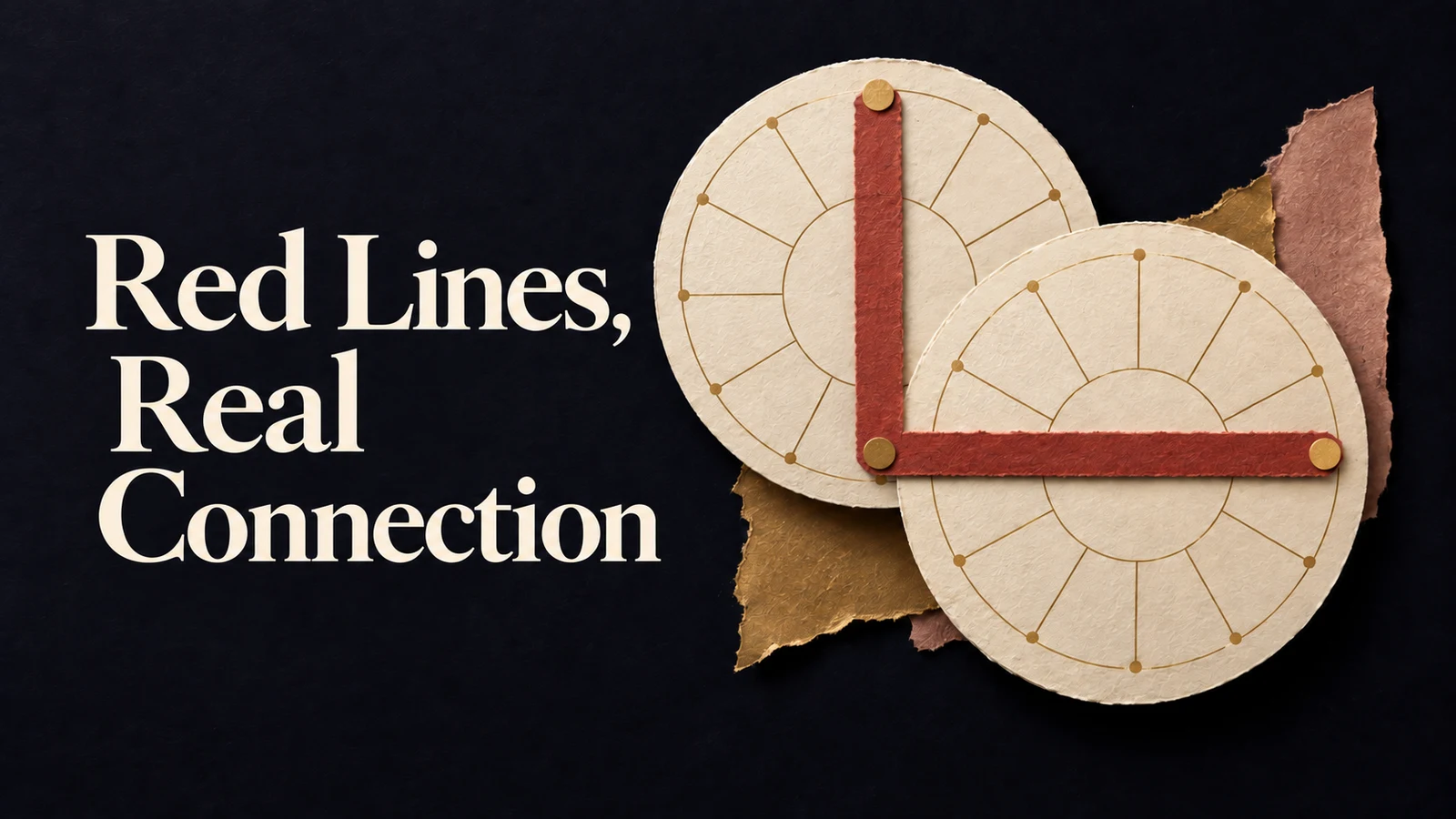
Perhaps this feels familiar: you can talk to someone for hours, you enjoy each other's company, and even your differences have become comfortable. Then, out of curiosity, you look up your synastry. So many red lines cross the chart that the picture suddenly looks harder to live with than the relationship does. Have you missed something?
You can still be a good match, even with plenty of red lines. The color identifies particular astrological angles. It is not a warning about how someone will treat you. How much red appears also depends on which connections the program chooses to draw.
Before interpreting the picture, it helps to step back. What does this particular line connect? How exact is its angle? And what experience of the relationship are you bringing to the chart? Those questions are just as useful for a long friendship as for a romantic partnership.
What a red line actually identifies
Synastry is the comparison of birth charts. Here, we are looking at connections between positions in two charts; astrologers call these angular relationships aspects. The method also applies to friendships and other relationships, as the Astrodienst introduction to synastry explains.
In Astrodienst charts, red mainly identifies squares and oppositions, while blue identifies sextiles and trines. These are color conventions for groups of aspects. When using another provider, check its legend before assuming that the same colors mean the same things.
A square is an angle of 90 degrees. Astrologically, it is associated with tension or friction; the Astrowiki entry on squares distinguishes the angle from its interpretation. The geometry can be calculated. Connecting it to a personal story is a further step.
The word “tension” leaves a great deal open. It tells you neither what two people argue about nor how they speak afterward. A red connection cannot tell you who is right in a disagreement, either. If your first reaction to the picture is to read red as danger, try naming the line precisely: “This is showing a square.” That gives you something specific to understand, rather than an alarming impression of the whole relationship.
Why the same two people can see different amounts of red
Two positions rarely make an exact aspect angle. The orb is the permitted distance from exactness, and astrologers use different tolerances. Consider a simple calculation: an angle of 94 degrees is four degrees away from an exact square. A setting allowing no more than three degrees excludes that connection; one allowing five includes it.
So you can enter the same birth data and see an extra line in one version. Nobody's birthday has changed, and no new discovery about the relationship has necessarily occurred. The program has simply used a different threshold to select what it shows.
Astrodienst even documents a difference within its own service. Its synastry drawing uses half the natal-chart orb, while the additional aspect table uses the full orb. The wider aspects are marked accordingly. The company explains that this display choice keeps the drawing clearer.
A shorter list of lines may therefore be a more tightly filtered view. Keep that in mind when comparing screenshots from different programs. Start with the settings and the actual aspect table before deciding that one provider has understood your connection better.
This need not turn into hours of technical investigation. For one line, begin with the two positions involved, the aspect name and the listed orb. Note which program produced the chart, too. You can then find the same connection again, even if its color, position on the page or line thickness looks different. Counting the red lines is too imprecise for that comparison.
One square, two people, several possible stories
Take an explicitly hypothetical example. Person A's Moon is at 12 degrees Gemini, and Person B's Moon is at 12 degrees Virgo. These positions are 90 degrees apart: an exact square. The placements simply make the geometry easy to follow. They do not come from a calculated chart for a real couple.
In astrological symbolism, the Moon represents, among other things, emotional needs and a sense of security. That suggests a question to explore together: what helps each of you feel comfortable, and where do your preferences differ?
Now give these two people an invented everyday situation. After a difficult day, A wants to talk immediately about what happened. B needs twenty quiet minutes first and would happily listen afterward. These preferences are chosen for the example; they are not claims about how people with these Moon signs behave. We are looking at what can happen when two people interpret an ordinary difference in different ways.
Without that explanation, A might take the silence as a lack of interest. B might experience the immediate conversation as a demand to be available at once. If they discuss only the chart, they might end up saying, “Our Moons just aren't compatible.” That sounds like an explanation, but it skips over the two preferences they could actually discuss.
A different conversation could begin: “I want to hear about it. Could I have a little time to settle in first?” A might reply: “Sure. Please tell me when you're ready, so I'm not waiting all evening.” Perhaps they agree to talk after dinner. Perhaps A realizes that this time it feels urgent and says so. They learn more about each other than the color of the line could tell them.
Their square does not disappear when they make that arrangement. They have simply clarified how they would like to spend their evening. It is equally possible that this difference barely matters to them, while something else causes regular disagreements. A useful interpretation needs to leave room for those answers.
A story about friction does not need a romantic gloss, either. Repeated belittling, pressure or ignored boundaries do not become necessary lessons because an aspect is described as difficult. In those situations, the behavior itself and what you need deserve attention. You do not owe a red line your patience.
Friendship and partnership ask different questions
You might particularly value a friend who disagrees with you. They ask questions you would never have thought of, and you can laugh together after a lively debate. Sharing a home could make those differences more noticeable. Two people who take a long walk twice a month do not have to negotiate a daily evening routine.
That is a good reason to keep the actual relationship in view while reading its chart. Do you want to live together? Do you work together? Do you meet rarely but reliably? A general description of two planetary positions does not automatically answer all those different questions.
Even within astrology, an individual red line is not read in isolation. Astrodienst recommends understanding each birth chart as a whole first. That involves more than adding up colored connections.
You do not need to begin an entire course of study to take something useful from this. Start by allowing a happy experience to remain a happy experience, even beside an angular chart. If your friendship has been dependable, that belongs in the conversation. You do not have to invent a hidden conflict to make a general description fit.
What you can do with this today
If your chart has unsettled you, begin with just one line. Choose a connection you have a clear question about and find it in the aspect table. Read its name and orb, then check the legend to see why it has that color. That can be the end of the technical work for now.
Next, think about the specific observation that interests you. “We are emotionally incompatible” is a very broad statement. “When I want to talk in the evening, the other person often needs some quiet first” describes something you can both recognize, add to or correct. The answer might also be, “That doesn't sound like us at all.” That is useful information, too.
If you want to talk about it, begin with the situation. You can explain that looking at the chart prompted the question. The other person does not need to accept an astrological interpretation to tell you when they can listen well or what they feel is missing.
Journaling questions:
- What had I actually experienced with this person before looking at our chart?
- Which worry began with the graphic or a general aspect description?
- Can I find an everyday example of the suggested tension, and an example that does not fit?
- What would I like to ask this person if I could not use any astrological terms?
One or two answers are enough. The most useful question opens a real conversation without deciding in advance what the other person must feel.
Reading the chart without overlooking the connection
When you find that red line again, you know its name and understand why it appears in the drawing. An alarming overall impression becomes something more manageable. You can stay curious while taking your experience of being together seriously.
Perhaps a question remains that you would like to explore in a personal reading. Perhaps you simply close the chart and arrange your next walk together. Your connection does not have to be effortless in every respect for you to enjoy it.
If you would like more thoughtful astrology in your inbox, join our newsletter. After confirming your email, you will receive the free moon-calendar PDF for October through December 2026. You also receive a one-time gift of 14 days of Mystic Plus when you sign in with a verified account using the same email address. It does not automatically become a paid subscription.

From the Zodiacally community