
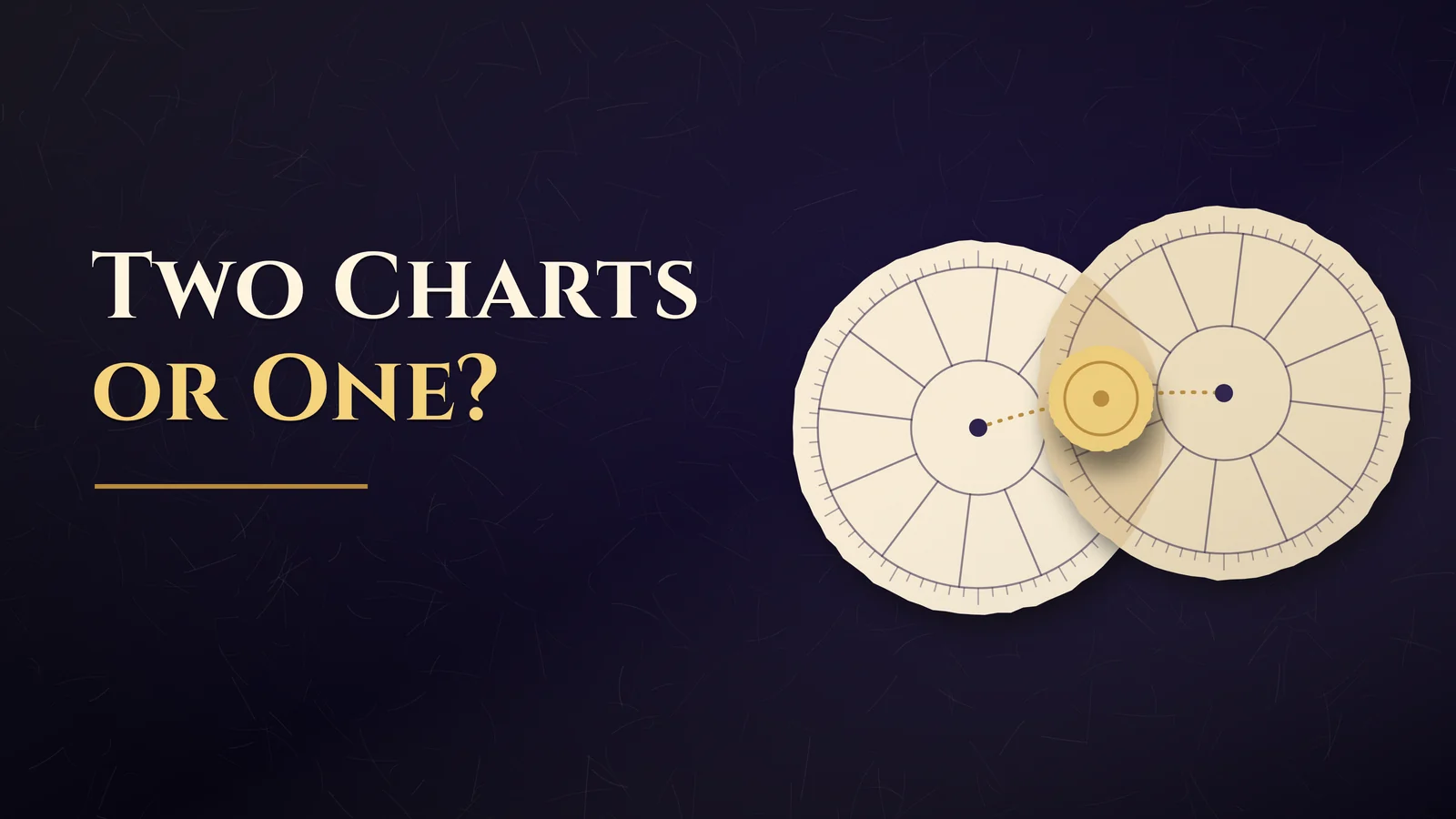
You have looked at your synastry with someone, and it made a certain kind of sense: your Moon touches their Venus, their Mars squares your Sun. Then a chart app offers you something called a composite, and suddenly there is a third chart on the screen with a Sun in a sign neither of you has. Which one is supposed to describe the relationship?
Both can, because they answer different questions. Synastry compares two birth charts and asks how two people affect each other. A composite chart combines both charts into one new chart and asks, within astrology, what the relationship itself is like when you treat it as its own thing. Neither is a score, and neither replaces what you already know about how the two of you get along.
That difference sounds small, but it changes how you read almost everything on the page. A square in synastry is a point of friction between two people. A square in a composite is read as tension inside the shared dynamic. Mixing the two levels is one of the most common reasons relationship astrology starts to feel contradictory.
Synastry: two charts side by side
Synastry is the older and more direct method. Astrodienst's partner FAQ puts it in one line: "Synastry is a comparison of two birth charts," and it "shows how the two partners interact or how they match." Nothing new is calculated. You keep both charts exactly as they are and look at how they connect.
Two kinds of connection do most of the work. The first are inter-aspects: angles between a planet in one chart and a planet in the other, such as your Venus forming a trine with their Moon. Kerykeion's introduction to synastry describes these as connections that "describe the felt experience of being together." The second are house overlays: where one person's planets fall in the other person's houses. If someone's Sun lands in your fourth house, astrologers would link their presence with themes of home and family for you, though not necessarily the other way around.
That last point is the heart of synastry. It is directional and personal. It can describe why one partner feels calmed by the other while the other feels mainly challenged, because each person's chart receives the other differently. Astrodienst also notes that it draws aspects in a synastry chart with half the orb of a natal chart, an orb being the margin by which an angle may miss exactness. A different program with wider orbs will show more lines between the same two people. That is a setting, not a change in the relationship, which we looked at more closely in our piece on red lines in synastry.
The composite: a third chart made of midpoints
A composite chart does something synastry never does: it produces one chart for two people. Cafe Astrology's composite chart guide explains that it "is derived by taking the mathematical midpoints between each person's planets and points." Your Sun and their Sun yield a composite Sun, your Moon and their Moon a composite Moon, and so on through the chart. The guide calls the result "the chart of the relationship itself."
The method became widely known in the 1970s. In a 2017 episode of The Astrology Podcast, John Townley is introduced as the first person to publish a book on the subject, in 1973. The show notes also say plainly what the result is and is not: a composite is "not a real chart that exists," it "does not reflect an actual chart with a time and location," and Townley calls it a "mathematical construct of mutual midpoints."
That is worth keeping in mind. No sky ever looked like a composite chart. A composite Venus and composite Mars sit where they do because of arithmetic, not because the two planets were ever there together. Astrologers who work with composites accept this and read the chart symbolically, as a picture of what two people create together. Others prefer a chart that is anchored in a real moment, which is where the Davison chart comes in.
A worked example: why a composite Sun can land in a sign neither of you has
Here is a hypothetical example, not a calculated real couple. Sam has the Sun at 10° Cancer, and Riley has the Sun at 10° Pisces. On the 360° circle of the zodiac, 10° Cancer sits at 100° and 10° Pisces at 340°.
In synastry, you simply measure the angle between the two Suns: 120°. That is a trine, read in astrology as an easy flow between the two people's core identities. Both Suns stay in their own signs, and the interpretation is about how a Cancer Sun and a Pisces Sun meet.
In a composite, you look for the midpoint. Here it gets interesting, because any two points on a circle have two midpoints, exactly opposite each other. If you just average the numbers, (100 + 340) ÷ 2, you get 220°, which is 10° Scorpio. If you go the short way around the circle, from 340° forward through 0° to 100°, the halfway point is 40°, which is 10° Taurus.
Most software uses the midpoint on the shorter arc, so Sam and Riley would have a composite Sun in Taurus. A RoxyAPI article on composite calculations is careful to call this choice "a convention rather than a law." So a composite Sun in a sign neither partner has is not an error. In astrology it would be read as the relationship's own center of gravity: here, perhaps, a shared wish for stability and comfort that neither Sun sign alone would emphasize as strongly.
The same article shows where this gets shaky. When two points are nearly opposite each other, both midpoints are almost equally far away, and a small change can flip the result to the other side of the chart. In its example, a 15-minute change in one birth time moved the composite Midheaven from Cancer to Capricorn.
The Davison chart: a relationship cast for a real moment
The Davison chart answers the composite's biggest weakness. Instead of averaging planet positions, it averages birth data. Astrodienst's FAQ defines it as "a chart that is calculated for the 'middle' in time and space between both natal charts": the moment halfway between the two births, at a place halfway between the two birthplaces.
Because the result is a real date, time and location, the Davison chart is a sky that actually happened. Cafe Astrology points out that it therefore includes things a composite cannot have, such as retrograde planets or eclipses. It is read in a similar way to a composite, as a chart for the relationship.
It has its own quirks. Astrodienst notes that the geographic midpoint "usually does not 'hit' an inhabited place like a city or town but can also lie in the middle of an ocean," and that there are several variants of the calculation. If two apps show different Davison charts for the same couple, check which variant each one uses before reading anything into the difference.
Which chart answers which question
Once you know what each method calculates, it becomes easier to pick the right one for what you actually want to understand:
- "Why do I react so strongly to this person?" Synastry. It shows how their planets land in your chart, and yours in theirs.
- "Why do we each experience the same relationship so differently?" Also synastry, because it is directional: the overlays in your chart and in theirs are not the same.
- "What are we like as a pair, and what do we build together?" The composite or the Davison chart, read as a chart for the relationship itself.
- "What is my own pattern in relationships, with anyone?" Neither. That question belongs to your own birth chart first.
That last point matters more than it looks. Synastry and composites both start from two natal charts. If you don't yet know your own Venus, Moon or seventh house, a relationship chart can easily turn into a mirror for worries you brought along. That is why a familiar piece of advice for beginners is simply to learn single charts first.
Where all three methods reach their limits
All three methods depend on birth times. Synastry between planets still works roughly without them, but house overlays and the Ascendant do not. A composite or Davison chart without reliable birth times has uncertain angles and houses, and the RoxyAPI example shows how far a quarter of an hour can move them. Programs also differ in how they derive composite houses, so the same couple can get several slightly different composite Ascendants from different calculators.
There is also a limit no setting can fix. A relationship chart describes symbolic themes. It does not show whether two people treat each other with respect, keep their agreements or want the same kind of life. A harmonious composite does not protect a relationship that isn't working, and a tense one does not doom a relationship that is. If you are weighing a real decision about someone, as in our piece on synastry and second chances, the chart can give you vocabulary for a conversation, not the answer to it.
Used that way, the two methods complement each other well. Synastry shows where two people touch each other's lives. A composite or Davison chart offers a picture of what grows between them. Reading the right chart for the question you are actually asking keeps both of them useful, and keeps the relationship itself at the center.




From the Zodiacally community