
Search for "Venus retrograde" over the next few weeks and you will find five calendars with five slightly different dates. Some say the retrograde ends on November 13, others on the 14th. Some mention Mercury, some don't. And almost none of them tell you what you can actually see in the sky.
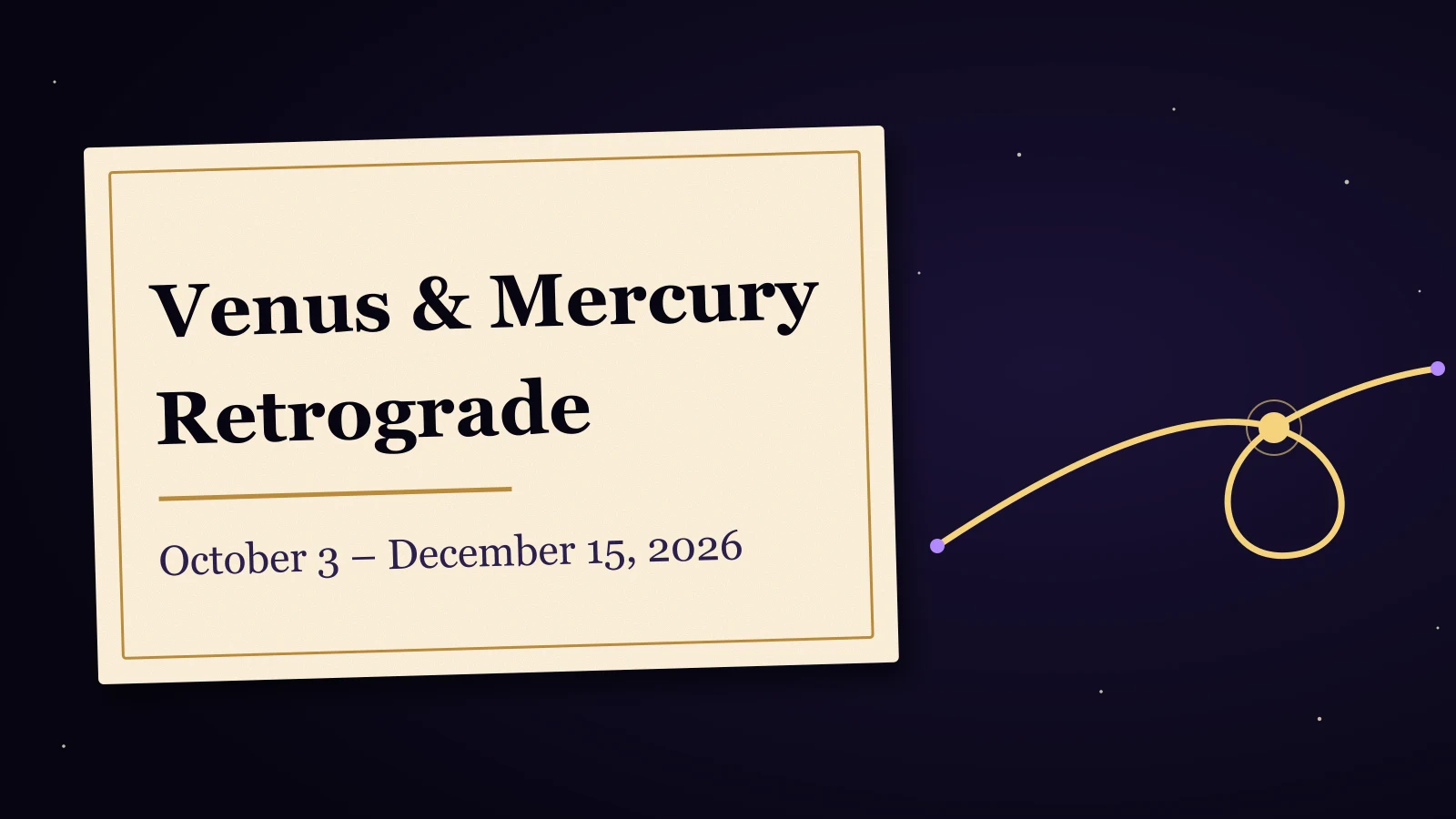
So here is the short answer first: Venus stations retrograde on Saturday, October 3, 2026, at 07:15 UTC, at 8°29' Scorpio. Mercury follows on October 24. In November the two turn direct again less than nine hours apart: Mercury on November 13, Venus just after midnight UTC on November 14. Venus's full loop, shadow periods included, runs from August 31 to December 15.
We calculated every date in this article ourselves with the Zodiacally ephemeris, based on the JPL DE440 planetary ephemeris (NASA/JPL), using the tropical zodiac and a geocentric view, and cross-checked the key ones against published calendars. Other ephemerides may differ by a minute of arc. All times below are UTC, so convert them to your own time zone.
The timeline at a glance
- August 31, 14:45 UTC: Venus reaches 22°52' Libra, the exact degree she will back up to in November. Astrologers call this the start of the pre-shadow, the stretch of the zodiac Venus crosses three times in this cycle.
- October 3, 07:15 UTC: Venus stations retrograde at 8°29' Scorpio.
- October 10, 15:50 UTC: New moon at 17° Libra.
- October 24, 03:44 UTC: Inferior conjunction. Venus passes between Earth and Sun. In the Americas this is still the evening of October 23.
- October 24, 07:12 UTC: Mercury stations retrograde at 21° Scorpio.
- October 25, 09:09 UTC: Retrograde Venus slips back into Libra.
- November 9, 07:02 UTC: New moon at 17° Scorpio.
- November 13, 15:53 UTC: Mercury stations direct at 5° Scorpio.
- November 14, 00:27 UTC: Venus stations direct at 22°52' Libra. That is still the evening of November 13 across the Americas, which is why some calendars list the 13th.
- December 4, 08:12 UTC: Venus moves forward into Scorpio again.
- December 15, 18:43 UTC: Venus is back at 8°29' Scorpio. The post-shadow ends and the cycle is complete.
If you compare these dates with other sites, the differences show up mostly around the end of the retrograde. That is almost always a time zone question, not a calculation error. CHANI lists the same Mercury stations on October 24 and November 13, along with the shadow periods.
What is physically going on
Retrograde sounds as if a planet turns around. It doesn't. Venus orbits inside Earth's orbit and moves faster than we do. About every 584 days she overtakes us on the inside track; NASA gives her synodic period as 583.92 days. In the weeks around that pass, our line of sight shifts so that Venus appears to drift backward against the background stars. Her orbit stays exactly the same. Only the viewing angle changes.
The middle of the manoeuvre is the inferior conjunction on October 24, when Venus sits roughly between us and the Sun. This time she slips about 6.6 degrees south of the Sun, according to EarthSky. That is also the moment the evening star becomes the morning star.
If you want to watch it happen, here is a rough guide:
- Early October: Venus is still in the evening sky, low in the west after sunset, and a little lower every week.
- Roughly October 18 to 30: she stays within about 11 degrees of the Sun and disappears in the glare. By our calculation that is 11.5 degrees on October 18, 6.5 degrees on October 24 and 11.3 degrees on October 30.
- Early to mid-November: she returns low in the east before sunrise. By November 15 she is 30 degrees from the Sun and easy to find. How early you catch her depends on your latitude and a clear horizon. Please never sweep binoculars anywhere near the Sun.
Mercury follows the same principle, only faster and less conspicuously. This time its entire retrograde stays in Scorpio and lasts a little over three weeks.
How astrologers read a double retrograde
From here we leave celestial mechanics and move into astrological interpretation. In astrology, Venus stands for what we value: relationships, attraction, money, taste. A retrograde is traditionally read as a review period, a time when things tend to be revisited rather than launched.
This Venus loop begins in Scorpio, a sign associated with depth, trust, what is shared and what stays hidden. Then Venus backs into Libra, where fairness, agreements and balance take the lead. A common reading therefore moves from "What do I really want, and whom do I really trust?" to "Is the arrangement I'm living in actually fair?" For how those questions can play out in relationships, from jealousy to shared money, see our article Venus Retrograde 2026: Intimacy Without Loyalty Tests.
What is new this autumn is the overlap. Mercury, the planet of thinking and conversation, is also retrograde from October 24 to November 13. For those three weeks both planets are moving backward, Venus still in Scorpio at first, then in Libra from October 25, and Mercury in Scorpio. Astrologers often read a stretch like this as a time when unfinished conversations and things left unsaid come back up.
You will probably see plenty of "your ex is about to text you" posts in the coming weeks. Nothing in the sky makes anyone send a message. What a review period can do is sharpen your sense of which old story still has a pull on you, and why. The answer to that sits with you, not with the calendar.
Check your own chart
The Venus loop spans 22°52' Libra to 8°29' Scorpio. If you have a planet or an angle (Ascendant or Midheaven) in that range, Venus crosses it three times between August 31 and December 15: forward, backward and forward again. Those are the placements astrologers would watch most closely this autumn.
A hypothetical example: your Sun sits at 2° Scorpio. Venus reaches that degree for the first time in mid-September, passes it again during the retrograde in the second half of October, and crosses it a third time in early December. With a placement like that, you can treat these months as one connected story: what showed up in September, what came back in October, and how things look by December.
Mercury's zone is smaller. It moves between 5° and 21° Scorpio and also covers that range three times between early October and late November. If you have planets in both zones, the overlap touches your chart most directly.
You can find your own degrees in any birth chart. You will need your date of birth, the most accurate birth time you have, and your place of birth. Without a birth time, the Ascendant and Midheaven are not reliable.
What you can do with this today
You probably know the usual rules for retrograde planets: no new haircut, no new relationship, no big purchase. Life doesn't pause for six weeks, though. It is more useful to treat the phases as a frame for a few honest questions.
1. Mark the four turning points: October 3, October 24, November 13 and November 14. That is all you really need to remember. 2. Check whether anything in your chart falls in the zone. If it does, write down what was on your mind in early September. That note becomes your point of comparison later. 3. Go and find Venus once. In early October look west in the evening, in mid-November look east in the morning. Seeing the same planet on opposite sides of the sky makes the loop more tangible than any calendar.
Journaling questions
- October 3 to 23, Venus retrograde in Scorpio: What do I want that I haven't said out loud yet, not even to myself?
- October 24 to November 13, both retrograde, Venus back in Libra from October 25: Which arrangement in my life still runs on an old agreement nobody has revisited? Who plans, who pays, who reaches out first?
- November 14 to December 15, the post-shadow: What has actually changed since the end of August, and what still holds?
An autumn for looking closer, not for standing still
The double retrograde is no reason to put decisions on ice. It is a chance to look more closely: at the sky, where Venus turns from evening star into morning star, and at your own life, where some agreement may have been due for a new version for a while.
If you want to know where Venus and Mercury sit in your own chart and which houses the loop touches, your personal birth chart is the place to start. And if you look back on these weeks on December 15, that note from September will probably tell you more than any forecast could.



From the Zodiacally community