
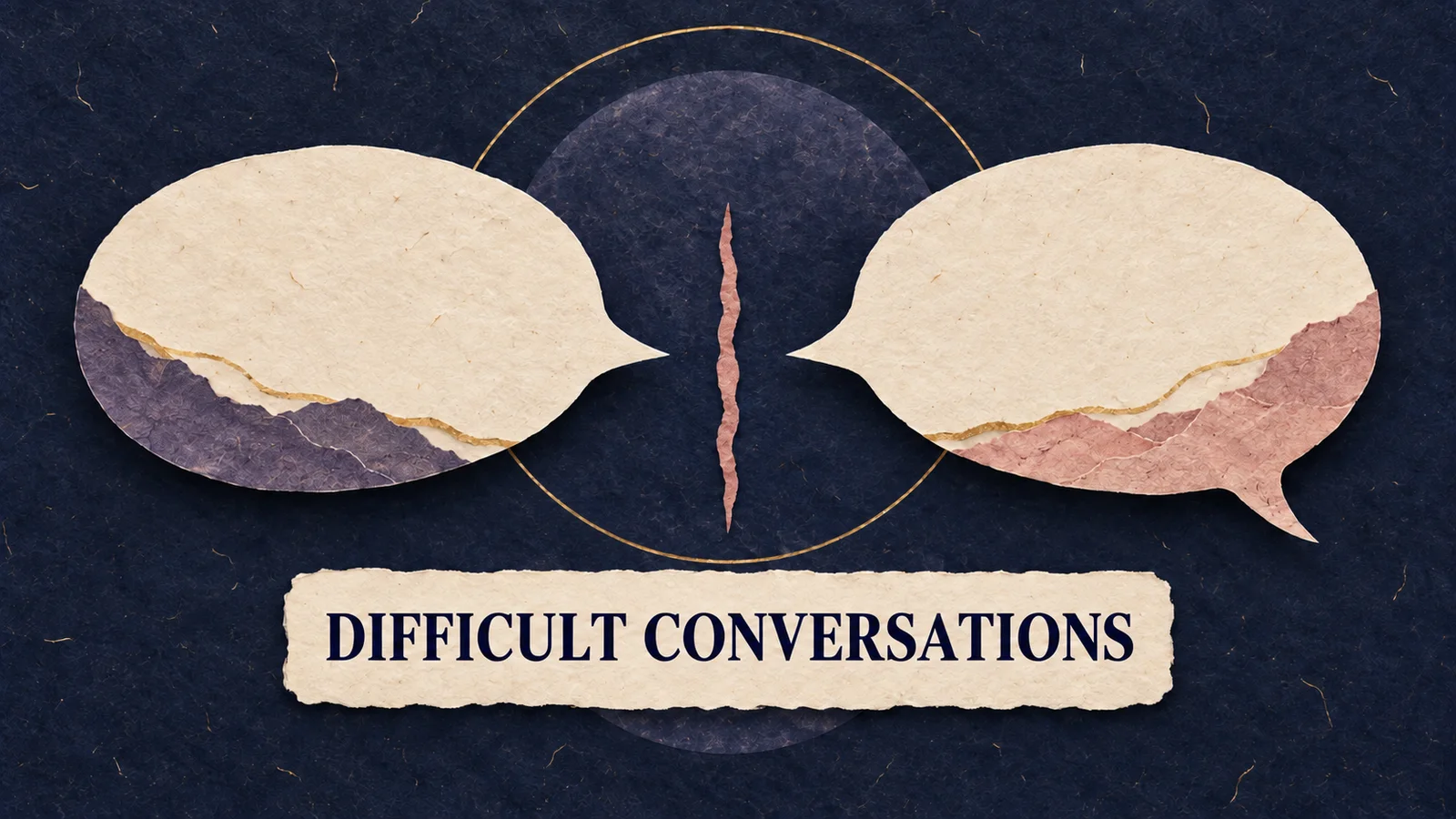
Some conversations begin long before the first sentence. You notice a clipped tone in a message, a delayed reply, or a serious expression. Before the other person explains what is happening, your mind supplies a translation: They are pulling away. I have broken something. This no means the connection is over.
Mercury opposite Saturn in 2026, exact on September 18, offers an astrological language for that compression. Mercury is associated with language, information, and exchange; Saturn with limits, delay, responsibility, and consequence. In an opposition, the two principles symbolically face one another. Every word can seem heavier, and a pause can easily feel like a verdict.
Human Design Gate 6 adds a separate lens: emotional friction, boundaries, and the question of when closeness is actually available. Together, the systems do not predict a breakup. They frame a more useful task: How can you speak honestly without trying to force closeness, agreement, or immediate resolution?
A difficult conversation is not automatically a failed conversation. Sometimes success means the truth can be spoken before agreement becomes possible.
What is actually happening in the sky on September 18, 2026
Mercury's opposition to Saturn is exact on September 18, 2026 at 09:52 UTC. The Dxpnet aspect calendar lists the time, while the daily planetary positions can also be checked in Cafe Astrology's 2026 ephemeris. In astrological terms, Mercury is in Libra and Saturn is retrograde in Aries.
Astronomy describes positions and angles. Words such as communication block, test, or maturity belong to astrological interpretation. No planet forces someone to send a cold message, and this aspect cannot tell you that a relationship will end. At most, it can serve as a time-based mirror: Where is communication becoming more exact, slower, or more consequential than you would like?
Libra symbolism seeks balance, a fair tone, and the other person's perspective. Aries symbolism emphasizes autonomy and the right to take a clear position. The opposition can therefore look ordinary. You want a sentence everyone can live with; the situation first requires a non-negotiable yes, no, or not yet. You want harmony; the conversation needs structure.
Saturn's contribution does not have to be pure rejection. A later appointment, a factual question, or a firm boundary can be uncomfortable and still useful. Trouble begins when the mind turns every limitation into a statement about personal worth. “I cannot discuss this today” becomes “You do not matter to me.” That translation deserves to be examined.
Mercury opposite Saturn: resistance is not a final verdict
Mercury wants to connect, name, and understand. Saturn narrows, tests, and asks whether something can hold weight. In a tense expression, this easily becomes fear of saying the wrong thing. You rewrite the same message five times, collect arguments like evidence, or explain every feeling so completely that little room remains for a real person to answer.
There is a more mature expression of the combination. Language becomes more precise. Promises become smaller and more reliable. A conflict is not smoothed over with friendly generalities; it is reduced to one sentence both people can use: “When plans change, I need a message.” Or: “I want to resolve this, but not tonight.”
A no can mean several things: a boundary, insufficient capacity, a different pace, or an actual refusal. Only conversation can reveal which one is present. Astrology should not skip that distinction. Mercury–Saturn symbolism is most useful when it leads to a testable question rather than a grim certainty.
This applies at work as well. Critical feedback may concern a draft rather than your competence. A delayed approval may indicate unmet conditions rather than hidden contempt. Saturn asks: Which concrete requirement is not yet met? Mercury asks: What information is missing before both sides can evaluate the same situation?
Human Design Gate 6: friction protects a threshold
Astrology and Human Design are different symbolic systems. Mercury and Saturn do not “activate” Gate 6 in this article. We are connecting themes editorially because both models have something to say about boundaries, timing, and communication.
In Human Design, Gate 6 is located in the Solar Plexus Center. Overviews such as the Jovian Archive's 64 Gates associate it with friction and emotional boundaries; together with Gate 59, it forms the 59–6 Channel, which carries themes of intimacy within the system. A detailed Gate 6 description emphasizes not only conflict but the regulating function of a threshold: not every person, subject, or moment is equally open to closeness.
That changes the question. Instead of “How do I remove the tension immediately?” you can ask, “Which boundary is this tension making visible?” One person may need more information; another may need time. The conflict may be workable, but not over text. Closeness may still be desired while a specific behavior is no longer acceptable.
Gate 6 is not a label for difficult people. An activation in a personal BodyGraph is not a diagnosis of conflict-seeking or fear of attachment. The symbolism becomes practical when it creates differentiation: friction can be a signal without being a catastrophe. A closed door today does not necessarily mean a closed relationship.
This is especially relevant to the emotional Solar Plexus. Strong feelings contain real information, but they do not always create immediate decision-readiness. In the Human Design system, emotional Authority is said to gain clarity over time. Someone with another Authority has a different process. The Jovian Archive introduction to Strategy and Authority presents them as individual decision mechanics, not tools for controlling another person's response.
The perfect sentence cannot manufacture intimacy
A common reflex in difficult conversations is verbal control. If I am kind enough, logical enough, or vulnerable enough, the other person must understand me. The thought often comes from a sincere desire for connection. It still turns language into a lever designed to produce a specific reaction.
Good communication improves the chance of understanding. It guarantees neither agreement nor reconciliation. You can offer a clear sentence; you cannot decide when another person is emotionally available. This is where Mercury–Saturn and Gate 6 meet in a useful way: speak responsibly, respect the threshold, and allow the reply to be a real reply.
That does not mean waiting passively or tolerating harmful behavior. A boundary may have consequences. “If you shout at me, I will end the conversation and we can try again tomorrow” is not a threat if you mean it calmly and follow through. “If you really loved me, you would talk now” is closeness under pressure.
Before the conversation, divide a page into three lines: observation, meaning, and request. Observation: “Our plans were cancelled twice on the same day.” Meaning: “I notice I am interpreting that as a lack of interest.” Request: “Can you tell me whether you still want to meet and what pace is realistic?” Your interpretation remains visible without being disguised as fact.
What you can do with this today
The conversation and Authority check
Start with the purpose check. Do you want to inform, understand, set a boundary, or receive immediate reassurance? More than one purpose may be present, but only one should lead the first sentence. “I want to understand what you meant by your message” opens a different conversation from “Tell me right now that everything is fine.”
Next comes the timing check. Is your body still inside a stress wave? Is the other person rushing, exhausted, or clearly unavailable? Postponing is not automatically avoidance. Offer a specific new frame: “This matters to me. Can we give it twenty minutes tomorrow at seven?” Without a new frame, delay can become fog; with one, it can be care.
The third step is the Authority check. What decision is actually present, and is it yours to make now? Strategy and Authority are not substitutes for communication skills. They can help you notice whether you are following your own process or simply trying to end the tension. With emotional Authority, a night of distance may be useful. With Sacral Authority, a concrete yes-or-no question may offer more information than an abstract future scenario. Other Authorities have other reference points.
Finish with the boundary check: What can you offer, and what will you do if no agreement is reached? A boundary describes your behavior, not the response you want from someone else. “I will not discuss this over text” is a boundary. “You must answer today” is a demand.
Journaling questions for difficult conversations
- Which observable fact am I currently confusing with my interpretation?
- Which response do I want to force so that my fear becomes quieter for a moment?
- What boundary protects dignity and contact at the same time?
- What would need to settle physically or practically before the conversation?
- Which decision remains mine even if the other person stays undecided?
Then write one sentence that is true without claiming to know the future. For example: “The short reply unsettled me, and I want to ask what it meant instead of guessing.” It is less dramatic than a prediction and much more useful.
When a conversation does not create closeness
Some conversations do not end with relief. The other person keeps their no, needs distance, or cannot take the responsibility you hoped for. That does not make your careful preparation pointless. Sometimes clarity means no longer confusing a boundary with hope.
Mercury-opposite-Saturn symbolism can help keep the outcome concrete. What was actually said? Which agreement exists? Which consequence is realistic? Gate 6 reminds us that intimacy has a threshold. You may want connection without manufacturing it against another person's will or capacity.
If conversations involve threats, coercive control, violence, or persistent fear, an astrology or Human Design check is not enough. Safety, qualified advice, and trusted support matter more than finding the perfect conversational moment.
Astrology and Human Design are for self-reflection and entertainment and do not replace professional advice.
One durable sentence instead of ten pieces of evidence
Mercury opposite Saturn in 2026 does not have to produce a heavy day. As a symbol, it can remind us that words become more dependable when they are not expected to eliminate all uncertainty at once. Human Design Gate 6 adds that closeness needs not only openness but a respected boundary.
The next step may not be the perfect speech. It may be one durable sentence: “I want to work through this, and I do not want to pressure either of us.” Then you listen—not to turn every no into a yes, but to discover what form of contact is actually available.
That is not a promise of harmony. It is the condition that may allow truth and closeness to exist in the same conversation.



From the Zodiacally community