
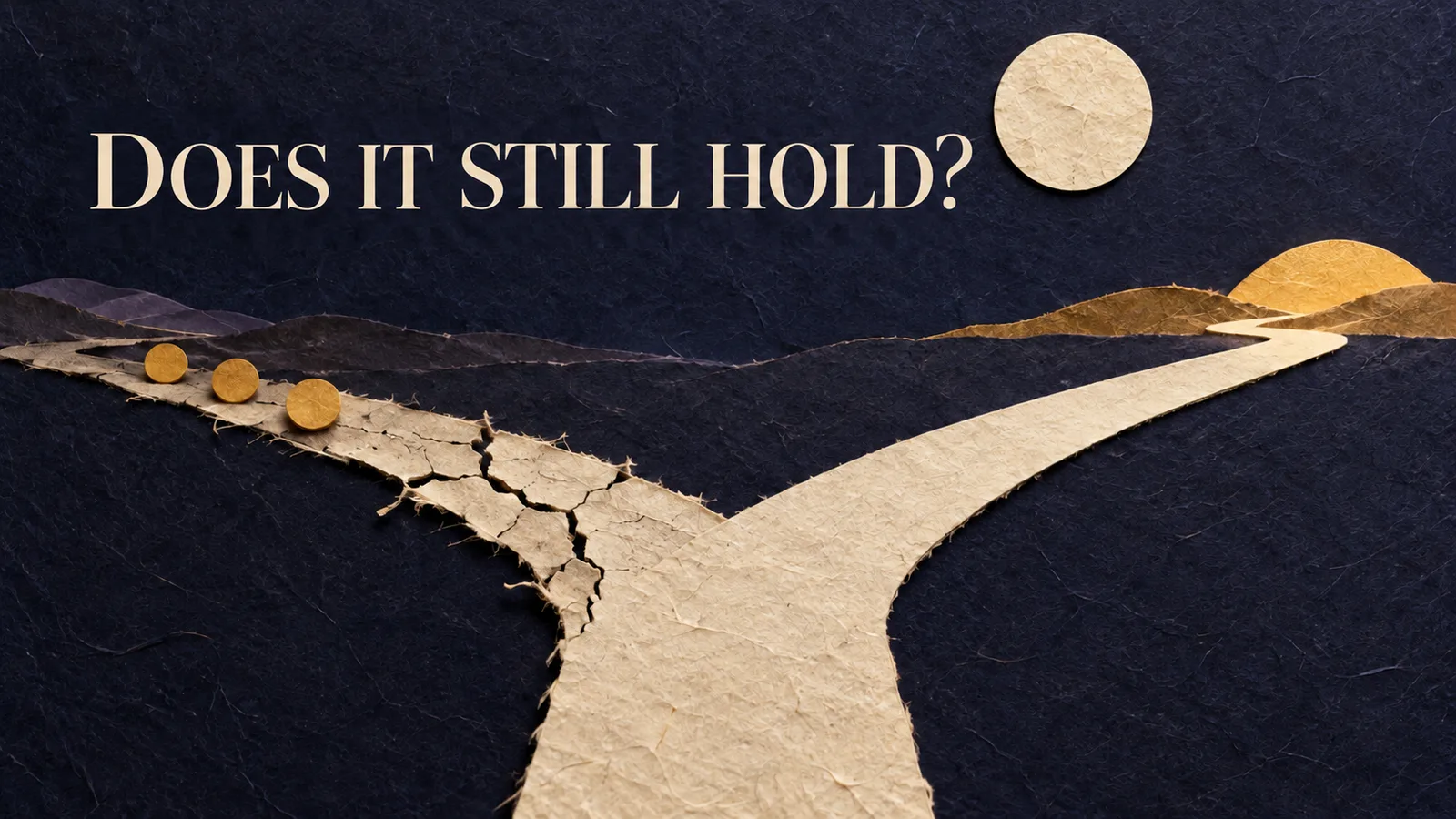
You have spent three years on a project. Or ten years in a relationship. Or so much money repairing something that walking away feels like waste. The sentence arrives almost automatically: I cannot stop now.
Sometimes persistence is wise. A difficult season does not make a good relationship worthless, and abandoning a project just before a viable finish can cost more than completing it. Past investment can also become an argument that overrides every new piece of information. At that point, you are no longer staying because the future looks convincing. You are staying because the past was expensive.
That is the distinctive question of the Taurus Full Moon 2026: What still gives you stability today, and what only feels impossible to leave because you have already invested time, emotion, or money? The Full Moon cannot decide for you. Its Taurus–Scorpio symbolism provides a reflection frame. The actual decision still depends on current evidence, future costs, and the value that continues to exist.
When is the Taurus Full Moon in 2026?
The Moon reaches its exact full phase on October 26, 2026, at 04:12 UTC. In Berlin, that is 5:12 a.m. CET. Germany returns to standard time the day before, so the local clock is one hour ahead of UTC that morning. The US Naval Observatory's 2026 phase data confirms the date and UTC time.
Astronomically, a Full Moon occurs when the Sun and Moon appear in opposite directions as seen from Earth. Sunlight then illuminates almost all of the lunar hemisphere facing us. That measurable phase does not say whether a relationship should continue or a project should end.
In the tropical zodiac used by most Western astrologers, the Moon is at 2°46′ Taurus, opposite the Sun at 2°46′ Scorpio. Cafe Astrology documents the degree and the square to Pluto. Pluto is near 3° Aquarius at the time. In astrological geometry, the Sun–Moon opposition therefore forms a tight T-square with Pluto: the two ends of the opposition each stand roughly 90 degrees from a third point.
Those degrees belong to an astrological coordinate system. The T-square is a calculable geometric relationship within that system; interpreting it as tension involving security, change, and power belongs to astrological tradition, not to established evidence of a psychological force coming from the sky.
What the sunk cost effect actually means
A sunk cost is a cost that has already occurred and cannot be recovered through the choice now in front of you. It may involve money, time, effort, or emotional energy. The classic work by Hal Arkes and Catherine Blumer described the sunk cost effect as a stronger tendency to continue an endeavor after resources have already been invested. The American Psychological Association record lists the 1985 paper as a foundational study of this decision bias.
Consider a simple example. You have spent €600 repairing an old appliance. Another component now fails. The €600 is gone regardless of your next choice. What matters now is forward-looking: How much will the new repair cost? How long is the appliance likely to work afterward? What would a suitable replacement cost? “Otherwise the €600 was wasted” answers none of those questions.
The label should not turn every act of perseverance into a mistake. Past investments can be connected to genuine current value. A course may be demanding, but the remaining credits still lead to a useful qualification. A relationship may be going through a hard period while both people reliably address a defined problem. A company may keep a machine because an independent assessment shows that repair is economically sound. In each case, the past is not the only reason; credible future benefits remain.
The better question is not simply, Have I already invested too much? It is: Would I choose the next investment if the earlier cost were not written on the page?
Why Taurus, Scorpio, and Pluto fit this question
In astrological tradition, Taurus represents continuity, material security, embodiment, possessions, and value built slowly over time. Persistence is not automatically the shadow side of Taurus. Much of what sustains us became stable through repetition: trust, savings, skill, and dependable routines.
The Scorpio Sun across the zodiac brings shared resources, dependency, loss, and change into the symbolic picture. The close Pluto square traditionally adds questions of control, power, and the price of holding on. If you want the longer astronomical and astrological background, our guide to Pluto direct in 2026 explains what a station is and offers a grounded power check.
Together, these symbols do not issue a cosmic instruction to let go. They support a useful comparison:
- Stability produces repeatable value, reliability, and costs you can continue to carry.
- Inertia mainly protects you from the discomfort of change.
- Sunk costs distort a choice when what has already been spent replaces an evaluation of the future.
- Control appears when uncertainty is not investigated but covered with still more investment.
Full Moons are often described as times of culmination or release. This article gives the moment a more modest job: it can be a date for reviewing one ongoing commitment using today's information. Not everything has to end. Everything may, however, be asked to make its case again.
Relationships: Shared history is not a forecast
Relationships are more complex than broken appliances. People change, commitments are mutual, and shared years do not become worthless when a relationship is struggling. Researchers have nevertheless studied sunk-cost reasoning in relationship scenarios. A paper in Current Psychology examined how previous investment affected choices in unhappy committed relationships; the Springer abstract states that focus directly.
This does not mean a long relationship should end. Duration is simply not evidence that the future will be good. Three questions help separate history from forecast:
1. What supports the relationship now? Look for respect, dependable care, shared responsibility, and willingness to address a specific problem. 2. What has actually changed after clear conversations? Look for observable behavior over a reasonable period, not only promises. 3. What future investment is being requested? More months, a move, shared money, or another delay of a stated boundary?
Imagine two people who have been together for eight years. For the past year, they have argued about the same unfair distribution of daily work. “We have built so much together” is understandable, but it is not yet a plan. Future-relevant evidence would be concrete: Were tasks redistributed? Does the agreement hold? Does the person who previously carried less take responsibility without constant reminders?
A sunk-cost lens cannot replace a full relationship assessment or a safety plan. It corrects one narrow piece of reasoning: shared history deserves recognition, but it should not be the only voice deciding the next commitment.
Work and money: Ending something is not always the loss
In a project, sunk-cost reasoning can look very tidy. A team has spent twelve months building a product, but its central assumption has failed. Instead of evaluating the new evidence, leaders commit another budget so the earlier work will not have been “for nothing.” The new spending does not recover the old investment. It only creates another one.
The reverse mistake is possible too. Stopping just before a realistic finish can waste value. Completing the final requirements of a qualification may have clear career benefits. Halting construction can trigger contract penalties and preservation costs. Real decisions include switching costs, opportunity costs, and consequences. Avoiding the sunk cost fallacy does not mean pretending that changing course is free.
A forward-looking comparison asks:
- What additional costs begin today under option A and option B?
- What benefit is realistically expected, and how will it be measured?
- Which assumption has changed since the original decision?
- Which costs are unavoidable whichever option you choose?
- Is there a smaller test before making another long commitment?
The Cleveland Clinic's practical explanation defines the pattern as staying because of time, effort, or money already invested and suggests asking whether you would make the same choice today without that history. It is not a perfect decision algorithm. It is a useful change of viewpoint.
A check: Does it still hold, or are you only holding on?
Choose one specific commitment: a relationship, project, subscription, repair, or role. Write four short answers without using astrological language.
1. Current return: What am I receiving now? Name a behavior, outcome, or function rather than a hope.
2. Future input: What must I invest from today onward in money, time, energy, or commitment?
3. Deciding evidence: What observable development would justify continuing? By when would it need to appear?
4. The clean-slate question: If I encountered this choice today without the backstory, would I enter on the same terms?
The fourth answer matters, but it does not decide everything. You might not begin a long friendship in the same way today and still value the closeness that has grown. You may know that switching is preferable but be unable to afford it yet. The check is not designed to flatten attachment into a spreadsheet. It is designed to keep the past from becoming the only voice in the room.
Three focused journal questions can take the review one step further:
- Which past investment do I mention most often when I explain why I am staying?
- Which current fact would I take more seriously if I had invested less?
- What small, observable condition must be met before further investment makes sense?
The Taurus Full Moon 2026 does not turn this into a fated decision. Astronomically, it is a lunar phase on October 26. Astrologically, the Taurus–Scorpio–Pluto configuration can serve as a picture of stability, fear of loss, and pressure to change. Psychologically, the sunk cost effect offers one plain correction: the past can be honored, but the next choice still has to answer to the future.
The free Zodiacally newsletter brings you more grounded astrology explainers and the current moon calendar by email. No account is required; confirm your email address to download the calendar.



From the Zodiacally community