

Two people are sitting on a sofa. The conversation is warm and familiar, yet a small hesitation appears. A question is asked. One gaze shifts away. One person wants to move closer; the other needs another moment. This is where the safety of intimacy becomes visible: not in how quickly distance disappears, but in whether both people can shape what happens next.
Human Design Gate 59 is often called the Gate of Intimacy or Sexuality. It sits in the Sacral Center and forms the 59–6 Channel with Gate 6, a connection associated in Human Design with bonding, fertility, and dissolving barriers. These descriptions can easily turn into promises of magnetic attraction. But closeness is not an energy that overrides consent, and openness is not an obligation.
A more useful question is not, “How can I become irresistibly open?” It is: Which barrier can soften, and which boundary is protecting trust right now?
Real intimacy does not define yes as the absence of no. It gives yes, no, and not yet equal dignity.
What Gate 59 describes in Human Design
In the BodyGraph, Gate 59 belongs to the Sacral Center, which Human Design connects with life force, work, sexuality, and reproduction. Its harmonic Gate 6 sits in the Solar Plexus. Together they form the Channel of Intimacy within what the system calls Tribal Circuitry. Traditional language uses the image of dispersion: something fixed becomes permeable so contact, exchange, or reproduction can occur.
This does not have to be read only as romantic or sexual. Intimacy can mean telling an unpolished truth, receiving help, creating something together, showing vulnerability, or refusing to hide conflict behind politeness. A barrier can be distrust. It can also be healthy caution, privacy, or distance that is still necessary.
Human Design is not scientifically validated. Gate 59 cannot diagnose your capacity for attachment or sexuality, and an activation does not prove special chemistry between two people. As a reflective language, however, it can open a precise question: what do you do with the impulse to reduce distance?
Intimacy is not the same as having no boundaries
Popular interpretations sometimes turn Gate 59 into a kind of magnetic intimacy frequency. The problem is not only exaggeration. It shifts responsibility. If connection is described as energetically inevitable, boundaries can start to look like resistance to something that is meant to happen anyway.
A sustainable relationship works differently. Closeness requires choices. You can share something personal without sharing everything. You can want physical closeness and stop at a particular touch. You can agree to a conversation but not to its timing. You can feel differently today than yesterday, even after years of trust.
Boundaries do not automatically prevent intimacy. They often make it possible. When you know your no will not be punished, your yes becomes more credible. When someone asks instead of assuming, the body may relax. When a pause is not dramatized as rejection, connection can survive difference.
Consent is specific, voluntary, and changeable
Consent is not a permanent blanket permission. It belongs to a specific action, moment, and group of people. It should be freely given, informed, and reversible. This is especially clear in sexual consent, but the principle helps in other forms of closeness too.
Consider ordinary examples:
- A personal story is not automatic permission to retell it.
- A hug yesterday does not eliminate the need to ask today.
- Access to a phone is not a mandatory proof of trust.
- A shared project does not grant unlimited access to time and energy.
- One person's emotional disclosure does not obligate the other to match it.
Silence, freezing, avoidance, or a hesitant “fine” are not enthusiastic agreement. At the same time, people should not have to express every boundary perfectly before it deserves respect. The person initiating closeness can slow down, ask an open question, and receive the answer without persuasion.
Gate 59 and Gate 6: openness meets friction
Gate 59 is not alone in its channel. In Human Design symbolism, Gate 6 brings emotional friction, boundaries, and questions of timing. This offers a valuable correction to romanticized Gate 59 language: dissolving a barrier is not automatically correct. Contact also needs discernment, emotional clarity, consequences, and mutual readiness.
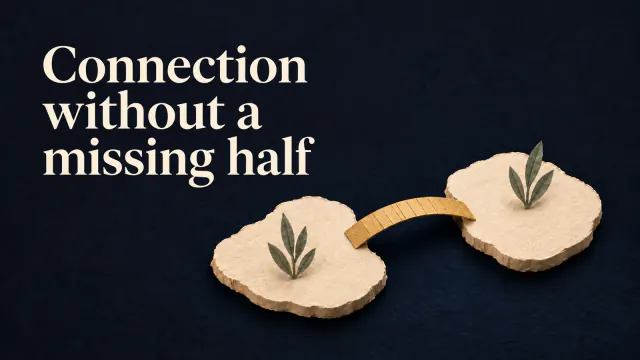
When only Gate 59 is defined in a chart, it may be described as a “hanging gate” attracted to the qualities of Gate 6. This should not become a relationship diagnosis. It does not mean you are incomplete or that a person with Gate 6 is your destined partner. You are not half a channel searching for completion.
Instead, observe when you try to create closeness to end uncertainty quickly. When do you encourage disclosure before knowing whether the setting is safe? When do you preserve distance even though an honest conversation might be possible?
Human Design relationships: chemistry is not a decision
A strong body response, intense synastry, or an electromagnetic connection in a composite chart can be fascinating. It does not tell you whether a relationship is respectful, compatible, or sustainable. Chemistry describes attraction. Relationship is built through repeated behavior.
Alongside any Human Design dynamic, check ordinary evidence:
- Are boundaries respected after a clear no?
- Can both people express needs without ridicule or punishment?
- Is there consistency between intense moments?
- Do both people take responsibility for repair after hurt?
- Do words and actions align over time?
- Can closeness grow without demanding isolation, control, or dependency?
If these foundations are missing, an energetically exciting channel will not make the relationship safer. If they are present, the connection does not need cosmic certification.
What you can do with this today: the intimacy check
Choose one relationship where you want more closeness or where closeness is creating pressure. It may be romantic, familial, friendly, or creative. Then move through five steps.
1. Name the closeness you want
What are you asking for specifically: more time, touch, honesty, support, commitment, or shared planning? “I want more intimacy” is too broad to answer fairly.
2. Separate desire from entitlement
A desire can be powerful. It does not become a claim on another person's body, time, information, or emotions.
3. Ask in a way that leaves room for no
A genuine question contains no hidden penalty. “Would you like to talk about this?” is open only if no does not lead to guilt, withdrawal, or a long campaign of persuasion.
4. Listen to pace and body language
Words matter, and context matters too. When hesitation appears, pause and clarify. You do not need to interpret uncertainty as agreement.
5. Agree on the next contact point
“Not today” does not have to mean “never,” although it may remain a no. A later check-in can create orientation without demanding consent in advance.
If Gate 59 is defined in your chart
With Gate 59 activated, you might observe that people tell you personal things quickly or that closeness seems to form easily around you. Do not treat that as proof of a special gift. Treat it as a reason for care. Confidentiality, clear questions, and a respected pace matter more than the intensity of contact.
You may also recognize an urge to overcome barriers. The question is not whether you must suppress openness. Ask whether the opening is mutual. A conversation can be deep without creating an obligation. A sexual bond can be intense without defining an entire relationship. Creative collaboration can feel intimate without erasing private boundaries.
If Gate 59 is undefined in your chart
An undefined Gate 59 does not make you less intimate or less capable of relationships. Human Design describes openness as a place where other people's energy may be perceived or amplified. As a hypothesis, you might notice whether you open more quickly in certain encounters than feels right once you leave that dynamic.
Do not wait for your chart to provide a universal rule. Strategy and Authority can support a personal pause, but they do not replace conversation. Consider safety, power differences, consequences, and whether you genuinely have the freedom to say no.
Boundaries when power is unequal
Consent requires special care when one person controls employment, money, housing, access, status, or professional evaluation. A technically spoken yes may still be shaped by fear of consequences. Human Design language should never be used by a coach, reader, manager, or partner to claim that someone is “designed” to open, bond, reproduce, forgive, or stay.
If pressure, fear, manipulation, or coercion is present, the priority is not energetic compatibility. Seek practical support from a trusted person or a qualified local service. A chart cannot make an unsafe dynamic safe.
Journaling prompts for Gate 59 and intimacy
- What kind of closeness do I specifically want right now?
- Where am I confusing intensity with trust?
- Which boundary makes my yes more honest?
- How do I respond when someone needs more time or space?
- Where have I assumed consent instead of asking?
- Which personal information is mine, and which was entrusted to me?
- After contact, do I feel freer and steadier, or smaller and obligated?
- Which relationship remains reliable outside its most intense moments?
The boundary belongs inside intimacy
Gate 59 symbolically reminds us that human beings can dissolve barriers. Its mature expression is not maximum openness. It is discerning. Which wall grew from fear and can be examined gently? Which door should remain closed today? Which threshold can only be crossed together?
Perhaps the two people on the sofa still have some space between them. A question has been asked, and the answer is, “I want this, but more slowly.” No one pushes. No one withdraws in punishment. The distance is not the opposite of intimacy. It is the room in which trust is being built.
Closeness does not become true when boundaries disappear. It becomes true when both people can move toward each other freely from within their boundaries.

From the Zodiacally community