
Picture an ordinary evening. An open calendar sits on the kitchen table. A friend asks whether you can help her move this weekend. You want to see her, and you also need a day to yourself. Then you read a post about a new era in which everyone is meant to follow their own authority. For a moment, it feels like the permission you wanted. But what does that mean for Saturday?
This is where a sweeping story about the future becomes interesting. It reaches into promises, expectations, and the amount of closeness you want. Before imagining a different humanity, it is worth considering the people you will actually meet this week.
Human Design 2027: Where the story comes from
Within Human Design, 2027 marks a predicted change in what the system calls global cycles. Jovian Archive describes a transition from the Cross of Planning to the Cross of the Sleeping Phoenix. In this teaching, collective support gives way to a greater emphasis on individual responsibility. That is why conversations about the year so often involve institutions, cooperation, and personal direction.
The story predates the current discussions. A Ra Uru Hu text published in 2018 connects the coming cycle with Gate 55. Someone discovering the subject today is encountering an established part of the Human Design teaching.
These sources document what the system claims. They do not independently establish that society or human biology will change according to this account in 2027. Here, we use the theme as a starting point for reflection. The everyday situations and exercises that follow are our editorial interpretation. You can try them without believing in a coming cycle change.
What the conversations reveal
In a Reddit discussion from June 2026, participants connect changes in work and relationships with the approaching year. Relief and hope sit alongside practical uncertainty. A July discussion, with replies continuing into August, asks how personal incarnation crosses relate to the anticipated cycle. These are individual accounts from an interested community, rather than a representative survey or evidence that a prediction is coming true.
For this essay, the useful tension is a question: can I remain true to myself while depending on other people? You do not need to have seen a BodyGraph to recognize it. You want to change your work while a shared household still needs organizing. You need quiet and miss company. You appreciate help and do not want it to give someone a permanent vote in your decisions.
A year on a calendar cannot settle these tensions. It can provide an occasion to describe them more clearly. The practical work begins when you can name the actual request, person, or commitment involved.
The square between the houses
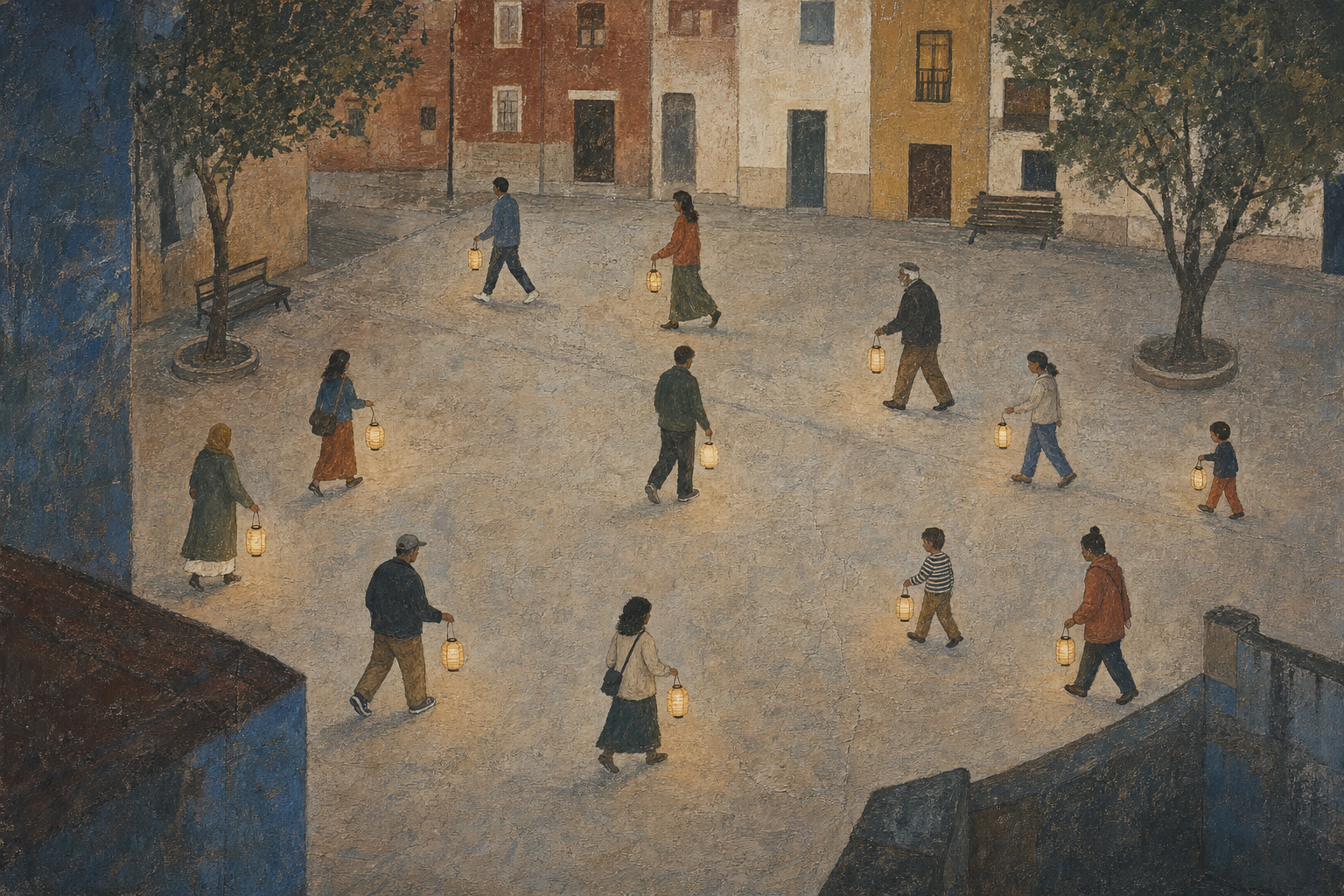
The artwork accompanying this article shows people carrying lanterns across a shared square. Each person holds a light of their own. They still walk on the same ground, between the same buildings. It is a useful image for independence: a personal path needs a setting in which it can exist.
In everyday terms, you can make your own decision while drawing on someone else's knowledge, time, or support. A friend might read an application. Someone might cover an appointment so you have space to think. An uncomfortable question might reveal a gap in a plan you were ready to commit to.
Receiving that help does not hand over your decision. The difficulty begins when help carries an unspoken condition: because I supported you, you should choose what I think is right. This is where a conversation about expectations matters. What exactly is being offered? Is anything expected in return? Could the person offering support accept an outcome different from the one they prefer?
Choosing your own direction can include asking someone to walk beside you.
When your yes promised too much
Return to Saturday. Perhaps you have already agreed to help with the move. Now you realize that a whole day is more than you can offer. Saying that your energy will not allow it leaves your friend guessing. Are you canceling, arriving later, or asking for understanding before a conversation you have not quite started?
You could be more specific: “I offered the whole day and misjudged my time. I can help carry things for two hours, but I need the afternoon to myself. Would that still help, or do we need to find another arrangement?” Your need, your earlier promise, and your friend's situation are all present in those sentences.
She may be disappointed. You may still keep your boundary. The conversation does not need to decide which person is right. Its purpose is to establish a next agreement that both people understand. Taking responsibility includes considering the effects of a correction. An early message, a clear departure time, or an honest acknowledgment may do more here than a detailed explanation of your Human Design type.
Closeness without constant availability
In some relationships, affection gradually becomes linked with being reachable. You answer quickly, check in, remember birthdays, and keep the conversation moving. Eventually, you want to do less. Yet you may not know whether the other person expects all this effort or whether you have made it your own condition for belonging.
Before withdrawing completely, try changing one habit and explaining it. You might say: “I'm checking my phone less in the evenings. Could we have a proper call on Sunday instead?” The relationship now has a recognizable arrangement. The other person does not have to decode silence to find out what is happening.
The outcome can remain open. You may feel more rested. You may discover that you value daily contact after all. Or you may finally talk about how different your preferences are. These observations tell you something about this particular relationship. They deserve more attention than the question of whether a friendship fits an approaching era.
You can also ask what works for the other person. Independence leaves room for hearing an answer you did not expect, then deciding together where your preferences can meet.
What you can do with this today
Choose one current situation in which independence and connection feel difficult to reconcile. Keep it manageable: an invitation, a recurring task, or a request for help. First, write down what was actually said and agreed. Then add what you are assuming. Unspoken expectations may take up more space on the page than the agreement itself.
- What did I promise? Record the words as accurately as you can, including when you said them. Has anything changed since then?
- What do I want now? Turn the wish into a specific request another person can understand and answer.
- What help could I accept? Include any conditions that would make the offer uncomfortable for you.
- What is mine to decide? Separate your choice from a response you cannot control.
- What could challenge my interpretation? Find one detail your current version of events gives too little attention.
Choose a small next step: ask a question, clarify an offer, or arrange a time to talk. The exercise does not require a special date. Its value becomes visible if something is clearer or more reliable afterward. If it is not, adjust the wording and look again at what you need.
You can revisit your notes after the conversation. Which expectation turned out to be shared? Which existed mostly in your imagination? Leave room for a result that is ordinary, mixed, or incomplete. That will give you more to work with than declaring the experience a success or failure based on a future prediction.
What your chart can leave open
A Human Design chart offers a vocabulary for differences within its own framework. It may help when all you can say is that something feels like too much. In conversation with another person, translate those terms back into everyday language. How much time do you need? What are you willing to take on? What information would help you respond?
Nobody needs to share your interest in Human Design to take your request seriously. You do not need a particular gate to want support. If you already know your BodyGraph, notice whether its language makes your questions more precise or helps you avoid a difficult discussion. A familiar interpretation can turn out to be a poor fit for the situation in front of you.
A personal Zodiacally reading can offer a starting point for considering your patterns. It cannot establish what will happen to you in 2027. Your everyday experience remains the place where you can assess whether an idea is useful.
For Saturday, the result might be surprisingly small: help for two hours, share something to eat, and go home afterward. An honest arrangement that gives both people room. Perhaps self-direction begins there, when you can describe your place among other people a little more clearly.




From the Zodiacally community