

A new notebook is waiting on the kitchen table. The first page is clean, the boxes line up, and for one brief moment the life ahead looks surprisingly manageable. Wake earlier. Eat better. Work with more focus. Scroll less. Read more. Everything receives a time, a color, and a convincing reason.
Then an ordinary Tuesday arrives. The desk feels noisy, the light is wrong, someone rings the bell, and the perfect plan begins to resemble a contract signed by a more optimistic version of you.
Virgo season 2026 begins on August 22 and turns the astrological lens toward details, work, health, skill, and useful improvement. That can feel relieving. It can also activate the old reflex to solve every difficulty with a stricter system. Human Design Environment offers a different point of entry: before asking how to control yourself more effectively, ask which surroundings support the action you want to repeat.
Perhaps you do not need the perfect routine. Perhaps your routine needs a place where it can breathe.
What Virgo season 2026 is really trying to organize
In astrology, Virgo symbolism is often associated with discernment. It looks beyond the large promise and studies the small piece that must work each day. How does an idea become a process? Where is energy leaking? Which task is useful, and which one merely looks productive?
This perspective can be especially valuable after the visibility and creative heat of Leo season. A vision may inspire you, but eventually it needs a calendar, a workspace, and a form that still holds on an average day. Virgo does not necessarily ask for more. It asks what could become more precise, simpler, and more dependable.
Under pressure, that quality can turn into constant self-correction. Fatigue becomes evidence of poor discipline. An interruption becomes a personal failure. A free evening becomes unused optimization space. The calendar starts to feel like a moral scorecard. This is where it helps to distinguish between a routine that supports you and a routine you use to monitor yourself.
Human Design Environment: Space belongs in the decision
In Human Design, Environment is an advanced variable often shown through the lower-left arrow of a detailed chart. Within the system, it does not identify the single city where you must live. It points instead toward spatial qualities in which your body may find it easier to process information, encounters, and ordinary life.
The six base terms are Caves, Markets, Kitchens, Mountains, Valleys, and Shores. They are archetypes, not real-estate instructions. Caves does not require a literal cave. Mountains does not demand an alpine home. A protected seat can carry a Caves quality, while a high balcony in a busy city can feel like Mountains.
Human Design is not a scientifically validated model of health or performance. Treat Environment as a language for observation, not a diagnosis or an order to move house. The useful question it creates is: Which spatial conditions change how easily I can begin, continue, and stop an activity?
That question matters beyond Human Design too. Habit research suggests that stable contexts and recurring cues can support more automatic repetition. This does not prove the six Human Design environments. It confirms a simpler point: behavior does not happen in a vacuum. The chair, the sound, the visibility of an object, and the path you take to reach it all participate.
The six environments without the relocation fantasy
Use the following descriptions as experiments. You do not need to guess your Environment, and a social-media quiz is not a reliable way to determine an advanced variable. Accurate birth data and a chart calculated for this layer matter. You can still observe these spatial qualities without turning one of them into a new identity.
Caves: choosing access consciously
Caves is associated with protected spaces, awareness of entrances and exits, and some control over who or what enters the environment. In daily life, this might look like a desk with your back against a wall, headphones, a door you can close, or a consistent seat from which you can see the room.
The routine question is: does the action become easier when interruptions are limited and boundaries are visible? A writing session may change simply because a sign is on the door or your phone enters a defined focus mode.
Markets: exchange and choice
Markets relates to places where goods, ideas, or people circulate. That might be a café, coworking space, active library, or a well-organized digital workspace. The quality is not maximum noise. It is the presence of exchange and available options.
The routine question is: do I need a lively field where I can choose, compare, or be carried by the fact that other people are already doing something? Some tasks begin more easily when activity exists around you.
Kitchens: letting transformation remain visible
Kitchens symbolizes mixing, processing, and transformation. It can be an actual kitchen, but it may also be a studio, laboratory, workshop, or team where unfinished material can combine. Everything does not have to look polished and complete.
The routine question is: does a place where tools can stay visible and work can remain in progress support me? For creative work, a prepared table may be more useful than a perfectly tidy room that hides every possible beginning.
Mountains: distance and perspective
Mountains is associated with height, distance, and overview. Practically, this could be an upper floor, a bright place near a window, a staircase, a quiet viewpoint, or simply a position that removes you from the immediate stream of activity.
The routine question is: does my thinking become clearer when I rise above or step away from what is happening? A strategy session may need a different table from the one where you answer messages and pay bills.
Valleys: paths, voices, and information flow
Valleys relates to connection, pathways, and acoustic or social information flow. A place near a street, hallway, conversation, or well-connected neighborhood may carry this quality. Some people do not need isolation; they need the feeling of being connected to a living line.
The routine question is: does a space where relevant voices, signals, or routes remain accessible help me? Learning might become easier in an environment where a question can quickly reach another person.
Shores: the threshold between worlds
Shores describes transitions: inside and outside, city and nature, work and privacy, motion and stillness. A balcony, conservatory, window seat, edge of a park, or lobby between two areas can express this quality.
The routine question is: do I need a visible threshold in order to change states? A short walk between work and evening may be more effective than demanding that you instantly “switch off” at the same table.
Why self-optimization often starts at the wrong end
Many routines are designed like character tests. Disciplined people complete them; people who fail did not want the result enough. Meanwhile, the plan may require daily concentration in a room that is simultaneously a bedroom, storage area, message center, and walkway. That is not a neutral background.
An environment-based routine changes friction first. The book waits where you actually sit. Your phone charges outside the Caves zone. Your workout clothes stand at the threshold near the door. The difficult thinking block gets the Mountains seat by the window. The sensitive conversation happens while walking through a Valley instead of between two browser tabs.
This is less heroic than a five-in-the-morning schedule. That may be exactly why it can become more sustainable. You do not need to prove every day that your will is stronger than your surroundings. You are allowed to arrange the surroundings so that they remind you without shouting at you.
A three-space experiment for Virgo season
Choose one action you want to stabilize during Virgo season: twenty minutes of writing, preparing dinner, a study session, a short meditation, or planning the next day. Do not choose something that replaces medical care or pushes your body beyond its limits. This is a modest daily-life experiment.
Try the same action in three different spatial qualities. Do not do all three on the same day, and do not turn the process into a competition. Each time, observe:
- How much runway do I need before I begin?
- What kind of interruption appears?
- Does my body become tighter, more alert, calmer, or more scattered?
- Can I stop cleanly when the agreed time ends?
- Do I want to return to this place?
Do not judge only by how much you produced. An unsuitable environment can generate impressive output while leaving a high cost. The better setting may be the one where you work less dramatically but can return more reliably.
What you can do with this today
Choose one recurring task and remove one environmental obstacle before changing the schedule. Put the required object in view, close an unnecessary path of interruption, or create a small transition into the activity. Keep the experiment reversible. Virgo season is well suited to careful adjustment; it does not need another total reinvention.
Then write a brief note after the task: where you were, what helped you begin, what pulled you away, and how you felt when you stopped. Repeat this three times before drawing a conclusion. The goal is not to prove your Human Design type. It is to collect honest information about the conditions in which your real life functions.
Journaling questions for routines that support you
- Which habit am I trying to rescue with pressure while its environment keeps working against it?
- Where do I begin meaningful things with surprising ease?
- Which spatial boundary would protect a task without making my life rigid?
- Does this activity need more protection, exchange, mixing, perspective, connection, or a threshold?
- Which routine could become smaller and still be true on an ordinary Tuesday?
Order that does not taste like control
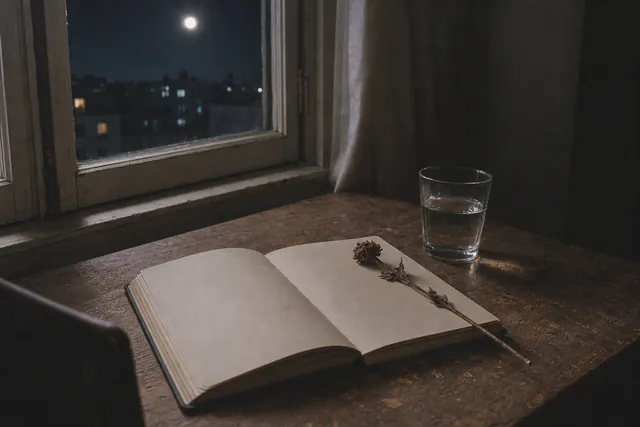
The mature expression of Virgo season is not perfection. It is care through precision. A glass of water placed where it will be reached. A task given a clear boundary. A table that does not need to look beautiful in a photograph because it is ready for an actual life.
Perhaps your new notebook stays open. Perhaps the plan inside becomes messier, shorter, and more honest. That is not the system failing. It may be the moment the system finally belongs to you.
A sustainable routine does not turn you into your best self every day. It helps your real self return.

From the Zodiacally community