
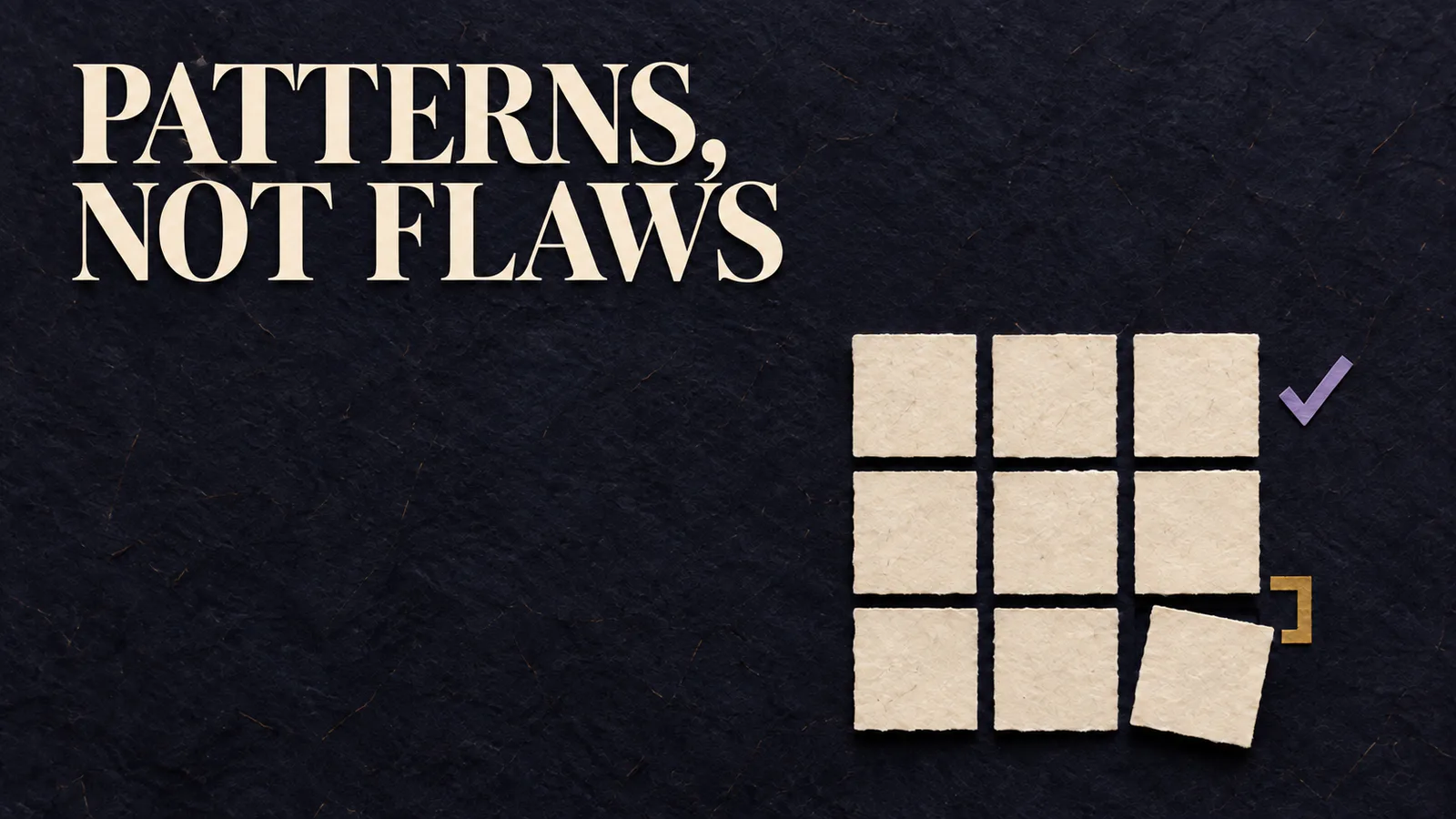
You open a file and immediately spot the one step that does not work. In a conversation, you notice the sentence that sounds needlessly sharp. In a familiar workflow, you can see why the same mistake returns every week. That perception can be valuable. It can also turn into a sentence that no longer evaluates the pattern but the person: “You always do this wrong.”
Human Design Gate 18 describes this sensitive boundary. Within the system, it is associated with correction: the capacity to notice what does not hold up in a recurring pattern and what might be improved. But seeing a flaw does not automatically give anyone permission to point it out, and it does not guarantee that the proposed solution is better.
The most useful filter for Gate 18 is therefore not, Am I right? It is: Is my feedback wanted, specific, and testable against an outcome? When one of those conditions is missing, improvement can quickly become criticism without a mandate.
What Gate 18 describes in Human Design
Gate 18 sits in the Spleen Center in the Human Design system. The International Human Design School presents it as “Correction — Work on What Has Been Spoilt.” It notices where something has moved out of balance or where a familiar pattern no longer works reliably. This is more than a preference for tidiness. The focus is on repetition, consequences, and whether a correction actually produces a better process.
Together with Gate 58, Gate 18 forms Channel 58–18, often called the Channel of Judgment. In this symbolic language, Gate 58 in the Root Center supplies pressure and vitality to improve conditions, while Gate 18 adds discriminating awareness. Jovian Archive's discussion of the channel also names its friction: in relationships, a continual focus on what could be improved may be experienced as constant criticism.
Gate 18 belongs to the Logic Circuit. Human Design associates this circuitry with recognizing patterns, testing repetition, and refining what proves dependable. A recent overview of the Logic Circuit describes its task as a cycle rather than a final verdict: observe a pattern, test an assumption, assess the result, and share only what has shown itself to be reliable.
That distinction matters when the word “judgment” sounds personal. Gate 18 does not have to decide whether someone is a good or bad person. Its constructive question is: Which part of this pattern repeatedly produces an unwanted result?
The September 27 to October 2, 2026 transit
The September 2026 Human Design transit calendar used here places the Sun in Gate 18 from September 27 at 12:04 a.m. with the Earth in Gate 17. The window continues through October 2, 2026. In the language of the system, correction, opinions, and the testing of patterns temporarily move into focus.
A transit is not a new natal definition. Your birth BodyGraph remains the same. In Human Design, a Just Now chart simply overlays current, time-limited activations on the natal chart. You might use that as an observation window: Do you notice more things that could be improved? Are you less patient with repeat errors? Or do you mainly notice how quickly other people present an opinion as a correction?
The calendar does not prove an effect on human behavior. Nor does the Sun in Gate 18 make anyone more objective, wiser, or entitled to judge other people. If you use the transit at all, treat it as a temporary question: Where would a correction genuinely help, and where am I merely looking for a flaw?
This boundary prevents another common overreach. Not every problem between September 27 and October 2 is “Gate 18.” A vague work brief is still a vague work brief. A hurtful comment still involves responsibility and communication. A transit can focus attention, but it does not explain every situation or make decisions for you.
Recognizing a pattern is not evaluating a person
Useful correction needs an object. That object might be a workflow, a paragraph, an agreement, a product, or a repeated behavior with a clear consequence. “The handoff step is missing, so the request stalls” identifies a pattern. “You are simply disorganized” turns an observation into an identity.
Four distinctions keep correction grounded:
- Observation, not label: What actually happened? A concrete event can be checked; a character diagnosis usually cannot.
- Pattern, not isolated error: Does this repeat under comparable conditions, or are you reacting to a one-off mistake?
- Consequence, not taste: Which result is affected? “I prefer it another way” is not a universal quality standard.
- Change, not devaluation: What small intervention could be tested? Criticism without a proposed action can produce shame without producing insight.
This precision also protects the person offering feedback. When you stay with the process, you do not have to prove that your judgment of another person is true. You can offer a limited hypothesis: “If we place ownership directly in the task, fewer requests may get lost.” Then everyone can observe whether the result actually improves.
Gate 18 becomes vague when “improvement” merely means that other people should adopt your preferred form. A better outcome therefore needs to be named in advance: fewer errors, a shorter wait, clearer language, a safer handoff, or a fulfilled agreement. Without a criterion, almost any personal preference can dress itself up as correction.
Consent determines whether feedback can land
Even an accurate observation can be useless at the wrong time. Human Design describes the Logic Circuit as collective and oriented toward sharing. But sharing works only when someone is ready to receive what is being offered. An unsolicited analysis after an exhausting day does not become helpful merely because it is phrased calmly.
Before offering feedback, one simple question is often enough: “Would you like an observation, or do you need space right now?” This is not decorative politeness. The answer changes the assignment. Yes opens a conversation. No sets a boundary. “Later” addresses timing rather than rejecting the relationship.
At work, consent may already be built into the role. Editing, code review, and safety inspection explicitly involve finding errors. Even then, the scope remains limited. A request for feedback on clarity is not automatic permission to evaluate someone's personality, work ethic, or entire strategy.
In close relationships, the mandate is often less clear. Ask which kind of response is wanted. Should you listen, reflect an inconsistency, or help design a solution? Without that distinction, you may try to correct a problem the other person was never asking you to solve.
Consent does not make your analysis correct. It only makes it receivable. Evidence, tone, and your willingness to be corrected still matter.
The three-part filter: wanted, specific, testable
Before you voice a correction or begin another round of self-optimization, check three conditions.
1. Is the feedback wanted?
Clarify the mandate. Ask whether feedback is welcome, what area it should cover, and whether now is a workable time. If the answer is no, decide whether the observation can be released or whether a genuine risk calls for a different channel. Safety issues, discrimination, and repeated boundary violations are not matters of style; they require clear boundaries and appropriate formal processes.
2. Is it specific?
Describe the observable event without “always,” “never,” or character labels. Name the context and consequence: “The status was missing from the last two handoffs, so the team had to follow up.” A specific sentence leaves room for disagreement and additional information. That is precisely what makes it more robust.
3. Can the improvement be tested?
Suggest a small change and a criterion: “For two weeks, let's add a status field and see whether follow-up questions decrease.” Correction becomes improvement when it is allowed to fail. If the test does not produce the desired result, the idea changes; the other person is not blamed for disproving it.
This filter works without a BodyGraph. It is an editorial application, not an official Human Design technique. That is also why it is practical: it translates the symbolism of Gate 18 into behavior whose quality remains observable.
When Gate 18 turns inward
The critical eye does not only point outward. It can search every draft, photograph, and personal decision for another fault. Correction then becomes an endless loop: one more revision, one more comparison, one more reason not to submit the work.
Self-criticism often sounds precise while remaining surprisingly untestable. “I'm not good enough” identifies neither a task nor a criterion. Translate it into a bounded working question: “Which passage is still unclear?” or “Which part does not yet meet the agreed requirement?” If no concrete answer appears, the issue may not be correction at all. It may be uncertainty, fatigue, or fear of evaluation.
Set a definition of done before you begin. A piece of writing might be finished when it answers the reader's question, the facts have been checked, and two revision rounds are complete. It can continue to develop later. Without an endpoint, Gate 18 can always find something that could be different.
It also helps to ask what already works and needs protection. A corrective gaze that registers only faults may dismantle the very part of a system that performs reliably. Improvement is not the greatest possible amount of change. It is a targeted adjustment with the clearest available benefit.
What you can do with this today
Choose one thing you currently want to improve: not a person and not an entire area of life, but one bounded process. Write down in one sentence what result it produces now and how you would recognize an improvement. Then ask someone involved whether they would like to hear your observation.
If the feedback is wanted, suggest only one small change for a limited period. Agree on what you will review afterward. Nobody has to accept your assessment as truth; the effect of the change provides new information. If the feedback is not wanted, keep the note to yourself and return to it only if there is a safety concern, a clear responsibility, or a later invitation.
Journaling questions
- What concrete observation remains when I remove every judgment about someone's character?
- Do I have a mandate to offer this feedback, and how could I ask for consent honestly today?
- What small outcome would support or challenge my improvement idea, and when will I review it?
Answer each question in no more than three sentences. Then write either a respectful request for a conversation or a small test with an end date. If neither is possible, your next action may be to leave the correction unspoken for now.
Good correction makes itself testable
Human Design Gate 18 offers a precise image for the point where perception needs responsibility. Recognizing an error is the beginning, not a license. Consent, a concrete observation, and a testable result are what turn the impulse into useful feedback.
From September 27 through October 2, 2026, pay less attention to how many faults you notice and more attention to what your correction produces. Does a pattern become clearer? Is there a small test? Can the other person disagree? Can you revise your own idea if the result does not hold up?
The strongest expression of Gate 18 does not need to diminish anyone. It moves attention away from a person's supposed flaw and toward the quality of a pattern—and accepts that the proposed improvement must also be tested.
Human Design is intended for self-reflection and entertainment. It is not a scientifically validated method of prediction or diagnosis and does not replace medical, psychological, legal, or financial advice.




From the Zodiacally community