
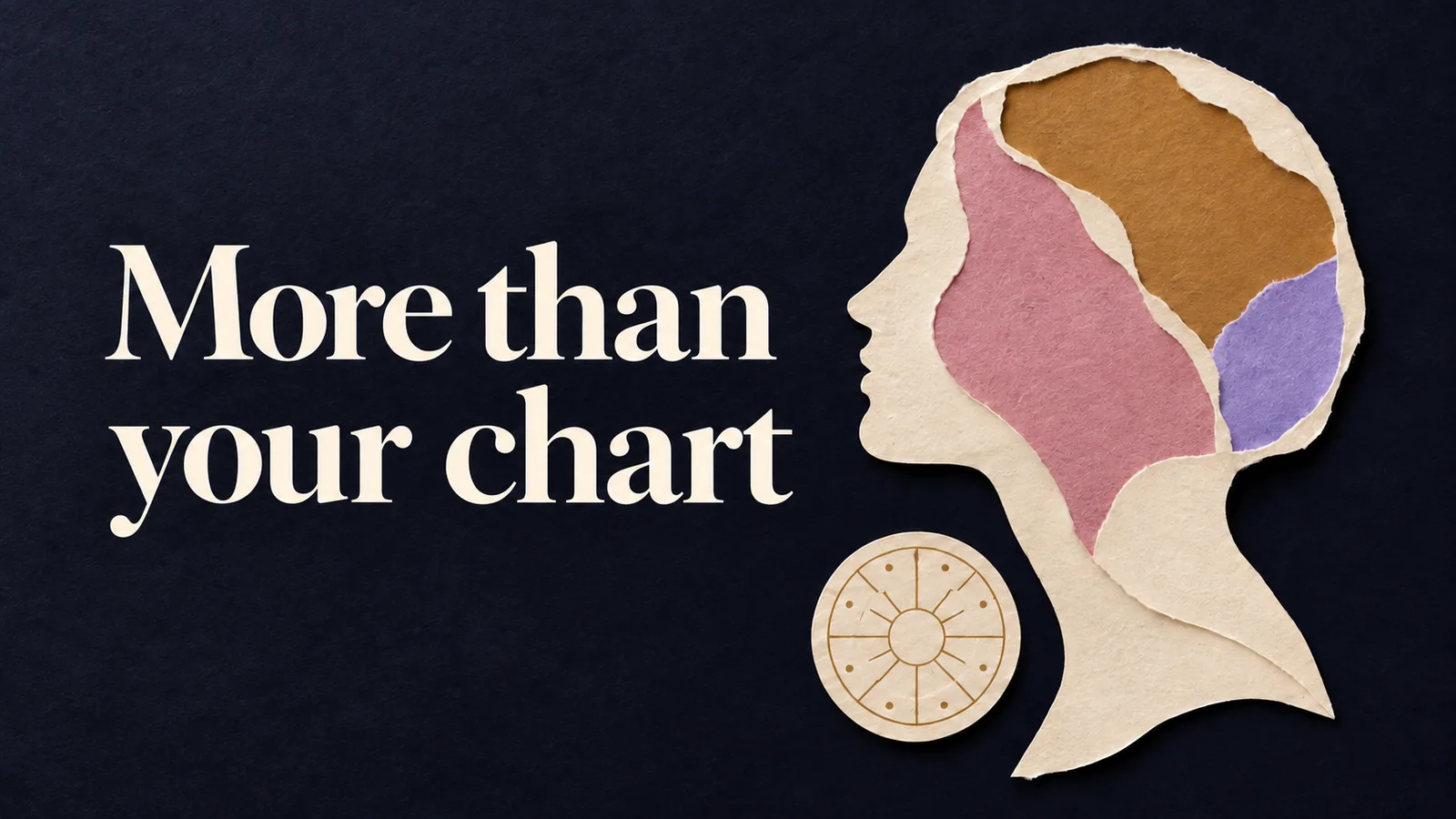
You read the description of your Sun sign. Sociable, spontaneous, always looking for something new. Then you look at your evening: the same favourite show, your phone on silent, grateful that nobody needs anything else from you. Perhaps you’ve looked up your Human Design, too. It says Generator, and you wonder why you feel tired so often.
At moments like these, curiosity can turn into uncertainty. Have I misunderstood my chart, the diagram of my astrological placements or Human Design? Am I somehow supposed to be different?
You don’t have to make yourself fit. First, check what a description actually claims, which part of your chart it refers to and whether you can recognise it in specific situations. Sometimes that makes a passage clearer. Sometimes it still doesn’t fit. You’re allowed to leave it there.
How a description becomes a label
A short sentence feels useful when you’re starting out. “Geminis are communicative” is easier to remember than a page of symbols. The trouble begins when it becomes “I should want to talk all the time.” An astrological association has turned into an expectation about your daily life.
Something similar happens with Human Design. A type name can sound like a complete answer to the question of who you are. Within the system, however, it names a particular chart category. It doesn’t simply tell you whether you enjoy parties, prefer quiet work or slept badly last night.
You also experience yourself in different settings. You might be animated with close friends, listen first in a new team and want to see nobody after an exhausting week. A description that skips those differences can feel familiar and completely foreign at the same time.
A smaller question is more useful than “Am I like this?”: In what situation might this description capture something? That gives you somewhere to begin. You’re looking for a clear connection between an interpretation and an experience, rather than trying to squeeze your whole sense of self into a paragraph.
And if the paragraph only tells you that you sometimes need closeness and sometimes need freedom? It’s worth asking what makes that statement specific. Recognising yourself in a description doesn’t, by itself, make the description particularly informative.
An astrological sentence has several parts
A birth chart represents celestial positions for a particular birth time and place. Astrological interpretation assigns symbolic meanings to those positions. The Astrodienst introduction already distinguishes planets, signs, houses and the relationships between them. Your Sun sign is one part of that picture.
Here’s a simple way to begin reading:
- Planet, Sun or Moon: What topic is being described? Astrological writing often groups the Sun and Moon with the planets, although neither is a planet astronomically.
- Sign: What style of expression does the interpretation suggest?
- House: Which area of life does the interpretation concern?
Mercury, for instance, is associated with thinking, learning and language. The hypothetical placement “Mercury in Taurus in the third house” can be unpacked as a learning exercise: communication is the topic; the sign suggests a measured, concrete approach; the house directs attention towards everyday conversation and learning. That might lead to a question: Does it help me to form a thought carefully before I say it aloud?
This is a simplified interpretation, rather than a complete analysis. Aspects, the angular relationships between factors in a chart, add further connections. You don’t need to know all their details yet to understand why one isolated sentence has limits.
Keep signs and houses separate as you learn. A planet in the third house isn’t automatically in Gemini. The Astrology Podcast explains these distinct reference systems in detail. Treating them as interchangeable accidentally turns different pieces of information into the same statement.
Two needs can exist alongside each other
Consider a fictional learning example, rather than a calculated personal chart. Mira has her Sun in Gemini and her Moon in Taurus. She becomes interested in new subjects quickly, but likes a manageable daily routine. After an animated conversation, she wants to go home, cook and have some quiet.
In the astrological meanings assigned to the Sun and Moon, different themes take priority: self-expression is among the Sun’s themes, while the Moon is associated with feelings and needs. Astrodienst describes signs as parts of a complex combination, rather than pure personality types.
In this example, Gemini might offer a way to explore curiosity and exchange, while Taurus might offer a way to explore consistency and tangible comforts. Mira wouldn’t need to decide whether she was “really curious” or “actually quiet.” She could be excited about a new cooking class and still enjoy attending at the same time each week.
The useful question sits in the actual situation: What does she want to discover, and what helps her feel comfortable while doing it? Two apparently opposite traits become two distinguishable needs.
Mira’s curiosity would, of course, exist without this interpretation. The example shows how astrological terms can be read together; it doesn’t establish a cause for her behaviour. If Mira didn’t recognise herself in it at all, “You just haven’t noticed it yet” wouldn’t be a helpful response. You can ask how an interpretation was reached and say when it doesn’t fit.
Human Design offers a different starting question
If you’re exploring Human Design alongside astrology, you’ll encounter the BodyGraph: the diagram of centres, connecting lines and numbers. You don’t need to learn every detail at once. The Jovian Archive beginner hub starts with Type, Strategy and Authority.
These terms do different jobs within the system. Type is a basic chart category. Strategy names the approach to opportunities and other people associated with that Type. Authority describes the decision-making process the system proposes. Jovian Archive explains this distinction between Strategy and Authority.
One distinction is especially useful for beginners: “Generator” doesn’t mean “extrovert,” and it doesn’t promise unlimited stamina. When you’re exhausted, sleep, workload and your actual circumstances deserve attention. A type name doesn’t explain that situation on its own.
Within the teaching, Generators are assigned a Strategy of responding. This refers to a response to something concrete that you encounter. Authority adds a decision-making process. For a Generator with Emotional Authority, for instance, the teaching recommends allowing clarity to develop over time, rather than treating the first mood as a final decision. Jovian Archive discusses this under Emotional Authority and its unfolding over time.
With a casual invitation, you could observe: Am I interested in this offer? How do I feel about it later, once the initial excitement or resistance has settled? That’s a limited exploration of an everyday situation. Time, cost and existing commitments also belong in that decision.
An astrological Moon sign and Human Design Authority aren’t interchangeable. They come from different rules and refer to different things. If you want to learn both systems, it helps to understand each term in its own context first.
A mismatch can remain an open question
Before adopting a description, take a quick look at what it rests on. Have the birth date, place and time been entered correctly? If the time is approximate, chart details that depend on it may be uncertain. An app can’t replace missing certainty with especially persuasive wording.
Next, look at the text itself. Is it describing a sign, an entire chart or a Human Design Type? Does it explain how it arrived at its interpretation? Does it allow for experiences that differ?
There’s a useful distinction here. “Perhaps I need time to settle into a new group” can be explored through specific situations. “Deep down, you’re different from who you think you are” avoids that kind of examination. If every mismatch is explained by saying you don’t know yourself yet, your own experience has little room to answer back.
You can keep three possible responses: This fits. This partly fits. This doesn’t fit me. You don’t have to reject an entire system immediately or rescue every statement it makes. When you’re learning, an honest open question is often more fruitful than certainty reached too quickly.
What you can do with this today
Choose one question to explore for a week. Perhaps: When does conversation make me curious, and when do I need quiet? Or: What changes if I ask for thinking time before a small decision that isn’t urgent?
Briefly note the situation and your response before rereading the interpretation. For example: “After three meetings, I wanted to eat lunch alone.” Only then add possible connections. This keeps what you actually experienced separate from what you later recognised in it.
Include a counterexample, too. Perhaps after another equally busy week you enjoyed having a friend drop by. What was different that time? Paying attention to differences makes your observation more precise. Seven days won’t prove a system. They can give you something more concrete to ask your next question about.
Journaling questions
- Which description caught my attention, and what specific situation does it bring to mind?
- When does that same description fail to match my experience?
- What need can I recognise if I set the type name or sign aside for a moment?
- Which question would I like to understand next, instead of collecting ten new terms?
When you discuss this with others, a specific question is easier to answer than “What does my chart say about me?” Try something like: “How do you distinguish the Moon sign from the Sun sign when their descriptions sound different?” It opens a conversation you can learn from.
Keep learning at your own pace
A good starting point gives you room to look more closely. You don’t need to know every symbol today or find the perfect description of your personality. One term you understand and one useful question already give you something to build on.
The free Zodiacally newsletter gives you the exclusive Moon Calendar through the end of 2026 and a one-time gift of 14 days of Premium.
Your next step might be quite ordinary: a sentence you understand more clearly, and an experience you no longer feel you have to make fit.


From the Zodiacally community